Some of the products featured in this article use affiliate links, meaning The Golf Player may earn a small commission if you make a purchase.
I often find watching pros practice is more interesting than watching them during tournament play. Sure, it’s fun watching them bomb drives, stick an approach shot or make a clutch putt on the course— it shows just how ridiculously good they are and under pressure, too. But watching them practice gives an insight into the methodology that got them to that high level.
One area I particularly love watching players practice is on the putting green.
While the average player might not be physically able to replicate the shoulder turn of Rory McIlroy or Bryson DeChambeau, just about any player has the physical ability make a putting stroke just as efficient as a tour pro.
I spent a lot of time during the Ryder Cup around the practice greens watching players putt, seeing what types of drills they were doing and what types of putting training aids (if any) they were using. If some of the best players in the world are practicing putting a certain way, perhaps there are drills or tools I could add to my own pre-round putting routine.
I’ve rounded up eight players I observed on the practice putting green at the Ryder Cup and detailed how they were practicing. While some of the techniques and putting training aids were more standard, like string lines, mirrors and putting gates, others were much more sophisticated and elaborate.
Perhaps the most interesting work I observed was done before any player arrived to the practice green.
Before Players Arrive
Phil Kenyon is one of the preeminent names when it comes to specialized putting instruction. Kenyon works with many of the top players in the world including Scottie Scheffler, Justin Rose and Tommy Fleetwood, just to name a few, and he was very busy at Bethpage making sure his players were at peak putting performance for the Ryder Cup.
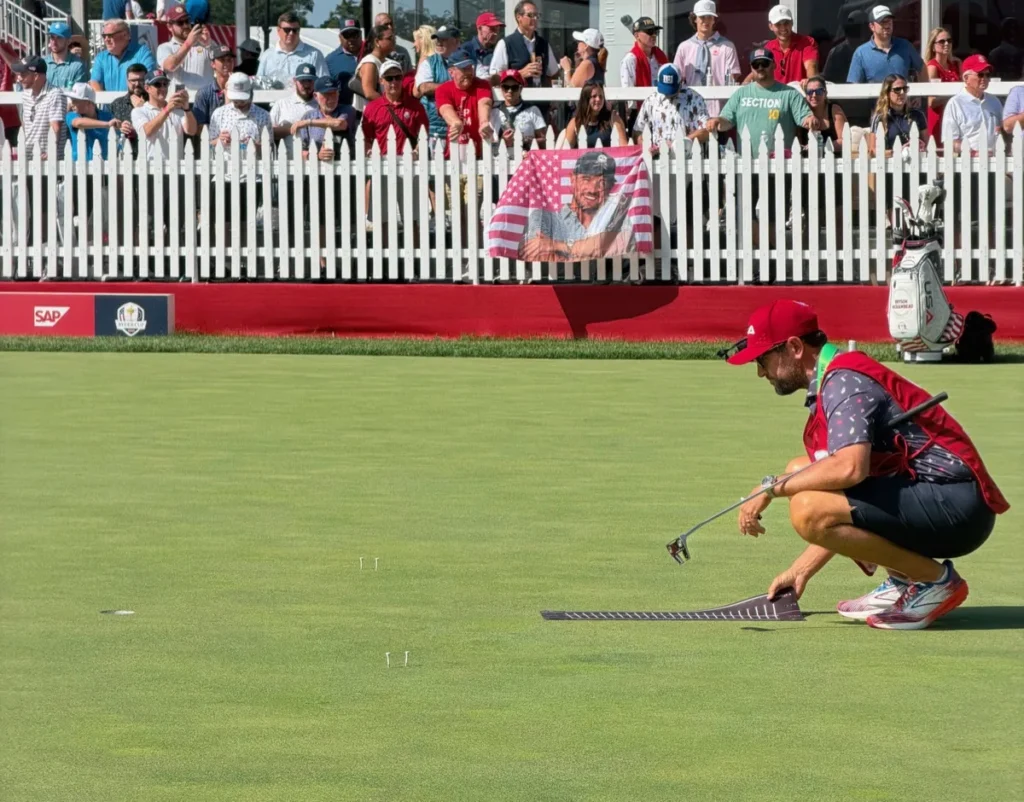
Prior to players arriving to the practice putting green, Kenyon set up several practice stations using a putting ramp to confirm breaks of putts, marking the start position and points along the break with a chalk pen.

These chalk marks are invisible from just about any distance off of the green and if you missed Kenyon’s prep work, it might look like players are putting from arbitrary locations—but their practice is anything but arbitrary. They are working with carefully mapped out stations that ensure maximum feedback and information. They know a well aligned and well struck putt at the correct pace will go in because they know exactly how that putt breaks.
Players that didn’t work with Kenyon had their caddies or dedicated putting coach set up similar stations using putting ramps to either find straight putts or confirm exactly what the break is before their players arrive.
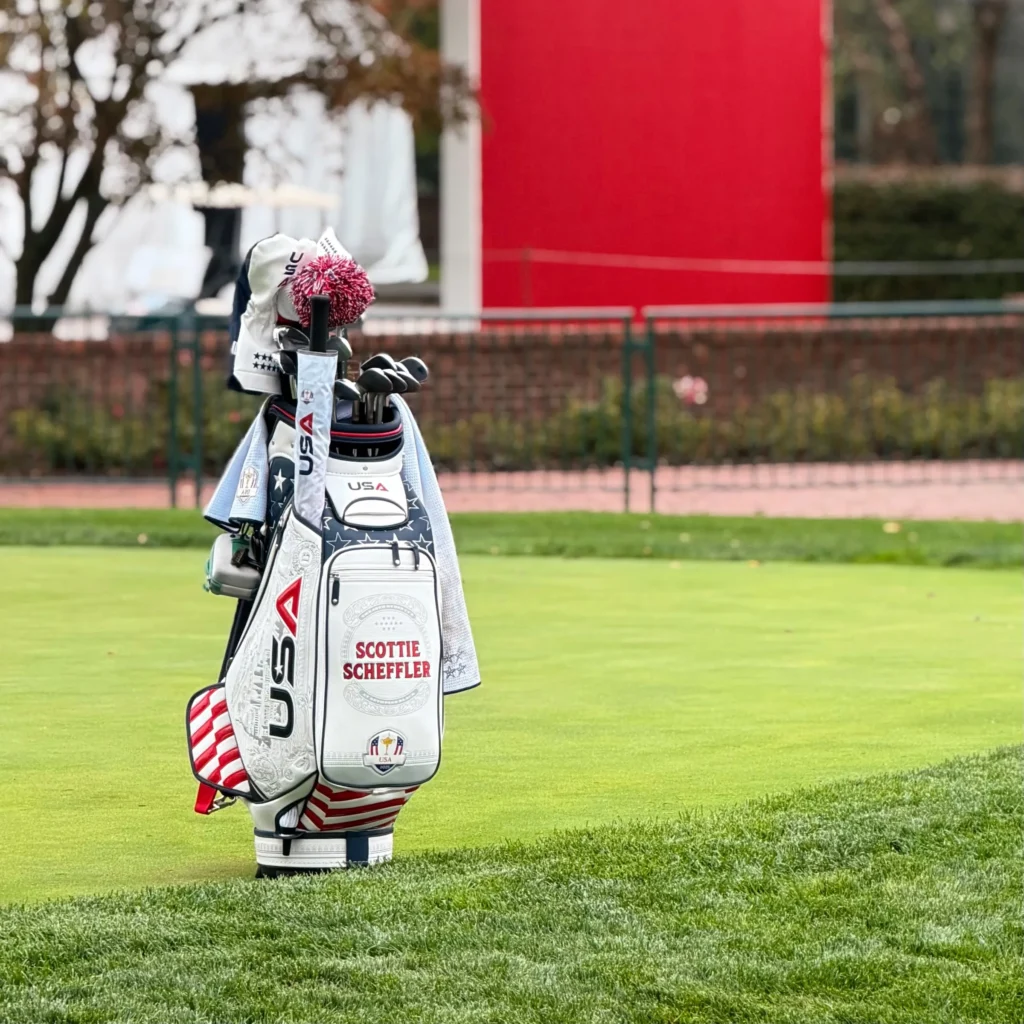
Scottie Scheffler
Putter: TaylorMade Spider Tour X L-Neck
Practice Aids: N/A
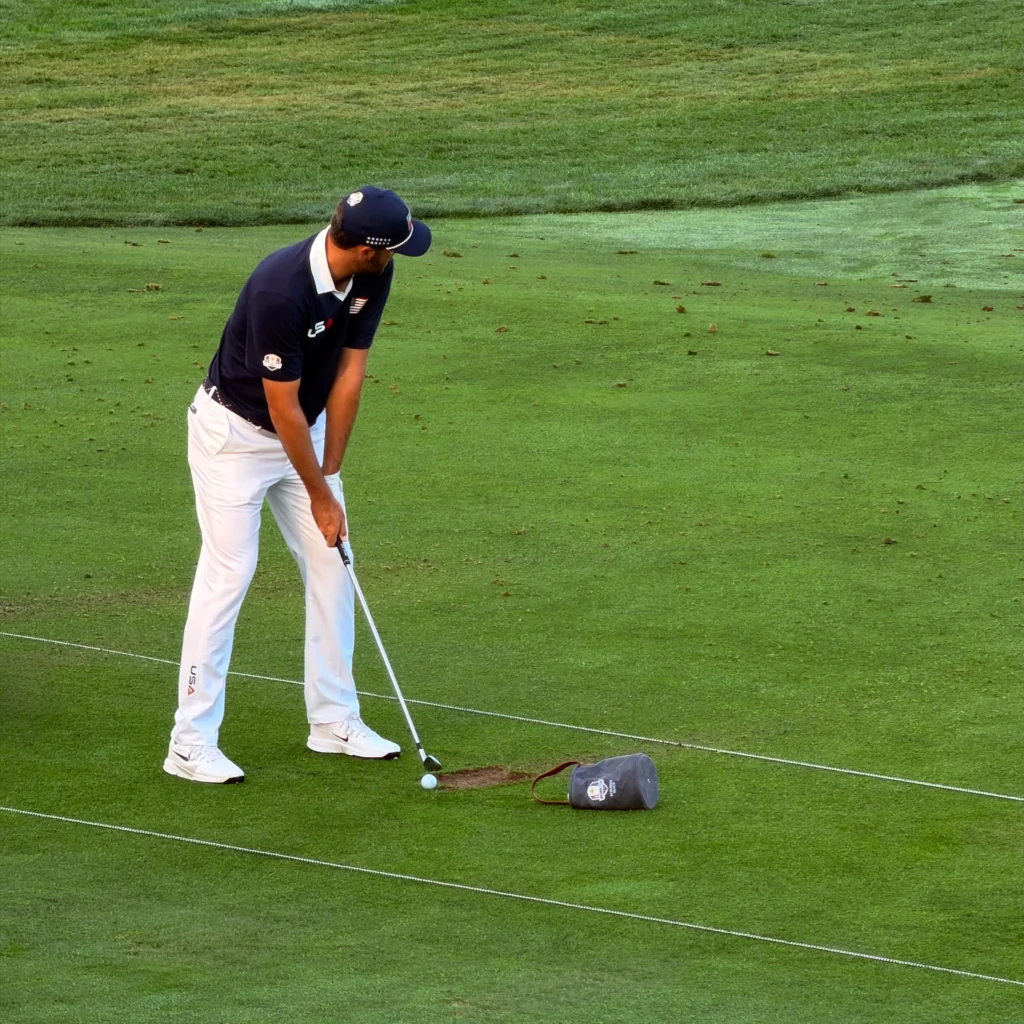
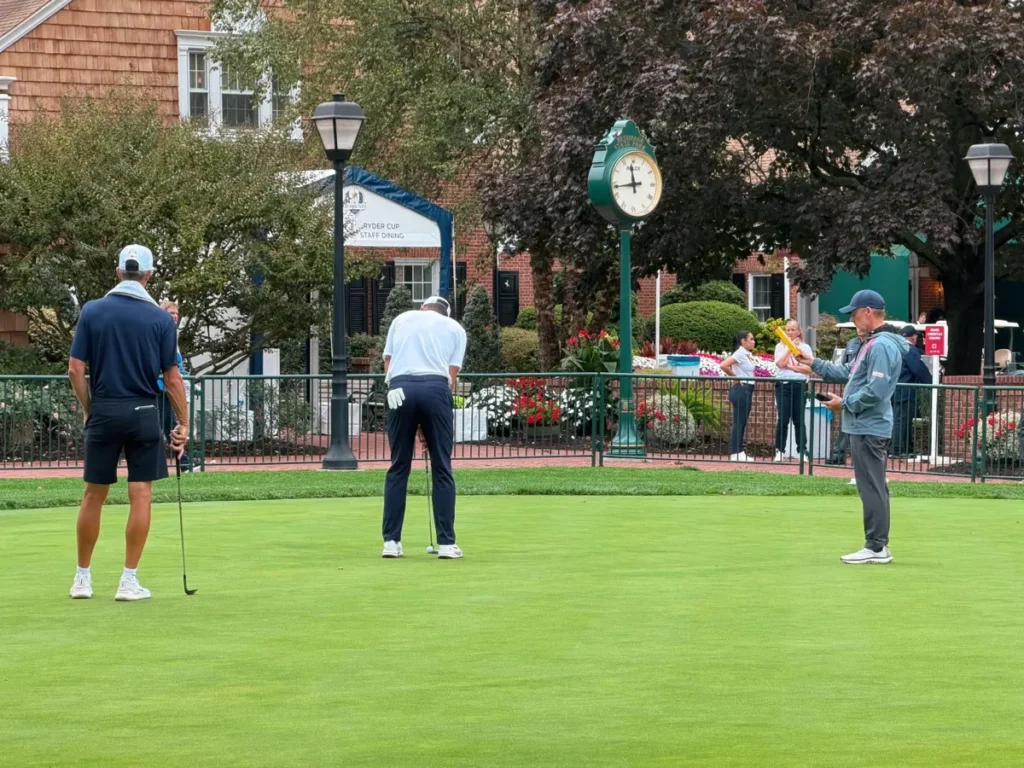
Scottie Scheffler spent time working Kenyon on a feel based and random putting practice approach, going through his full putting routine for each putt without the use of any practice aids.
Scheffler’s caddie, Ted Scott, set up random putts for the world number one, placing one ball at a time to different holes using a wedge to measure putts exactly three or four wedges-lengths in distance. Simply put, Scheffler was focusing on the 9-12 foot range.
Once you get outside seven feet the chances of making the putt for a tour pro drops off significantly. For the 2025 season, Scheffler’s make rate at seven feet was 71.67%, ninth best on the PGA Tour. At just two feet longer that percentage for Scheffler drops to 45.65% and 36.84% between 10-15 feet.
Scheffler ranks first in Approach the Green and Proximity to the Hole strokes gained statistics, so even one additional 9-12 footer made in that 35-45% make rate distance offers him a great area of opportunity to pick up strokes on the field.
Justin Rose
Putter: Scotty Cameron T-5
Practice Aids: Digital Level, String Line, Visio Putting Gate
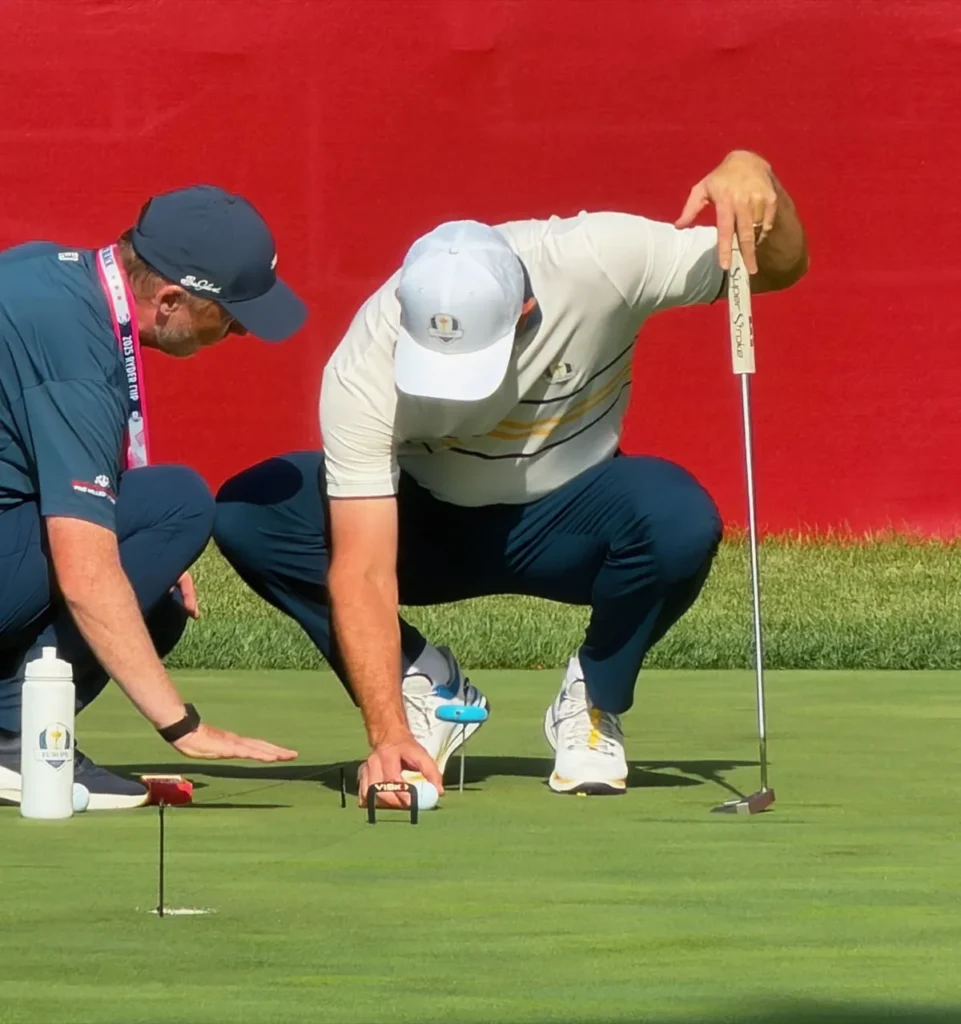
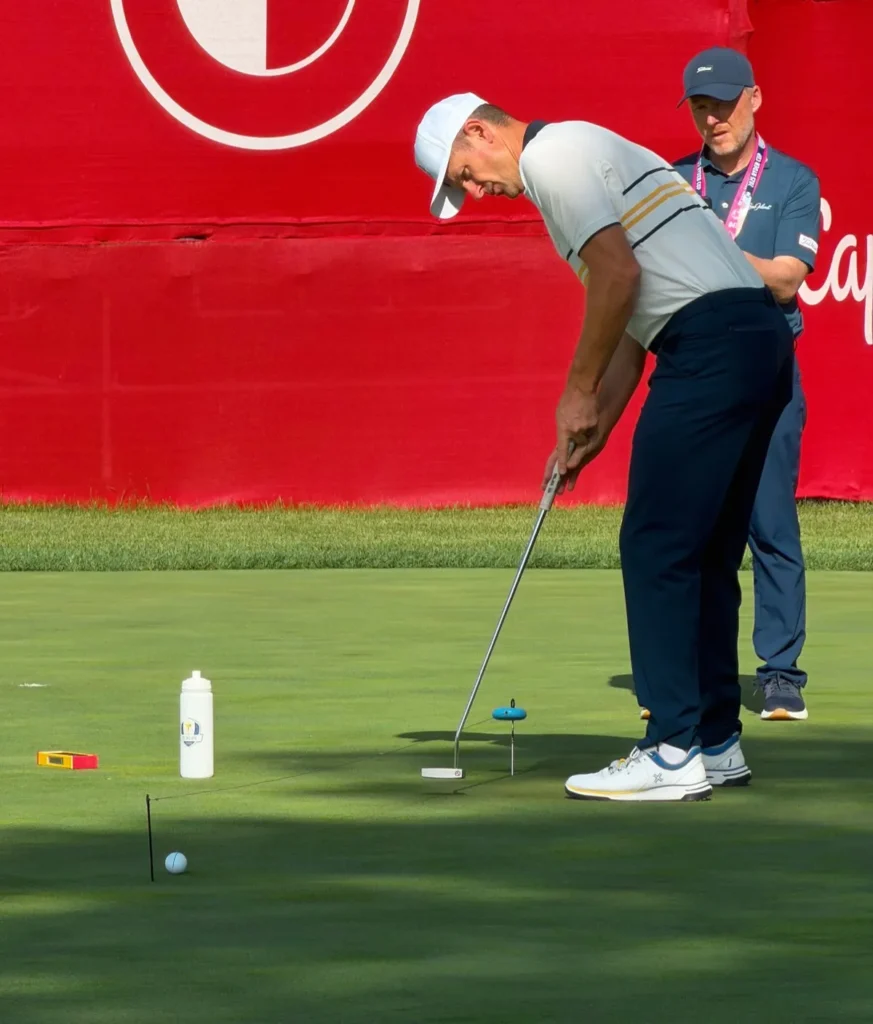
Justin Rose worked with his long time putting coach Phil Kenyon on setup and start line using a string line and Visio Putting Gate. Rose lined up the line on his ball through the center of the putting gate which would also line up with or be parallel to the string line when viewed from above, depending on his intended eye position over the ball. Rose then removed the putting gate and used the string line on a straight putt, putting not to a hole but to the post at the end of the string line.
Collin Morikawa
Putter: TaylorMade Spider Tour-V
Practice Aids: Digital Level, Tape Measurer
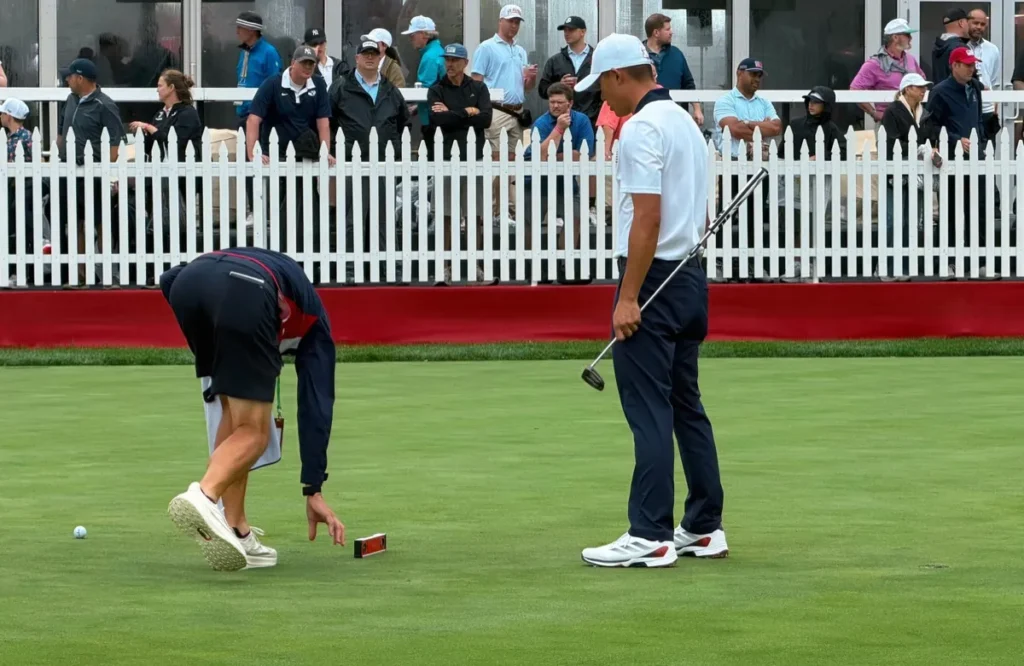
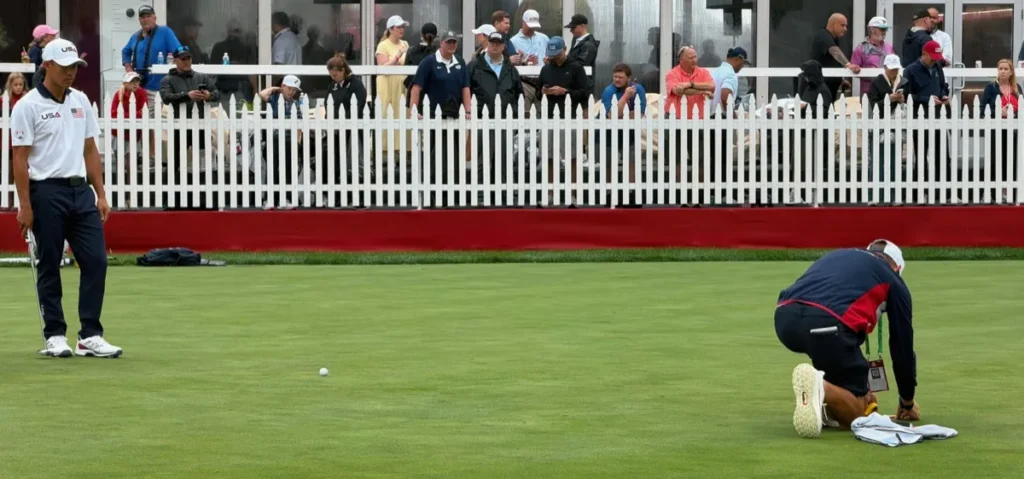
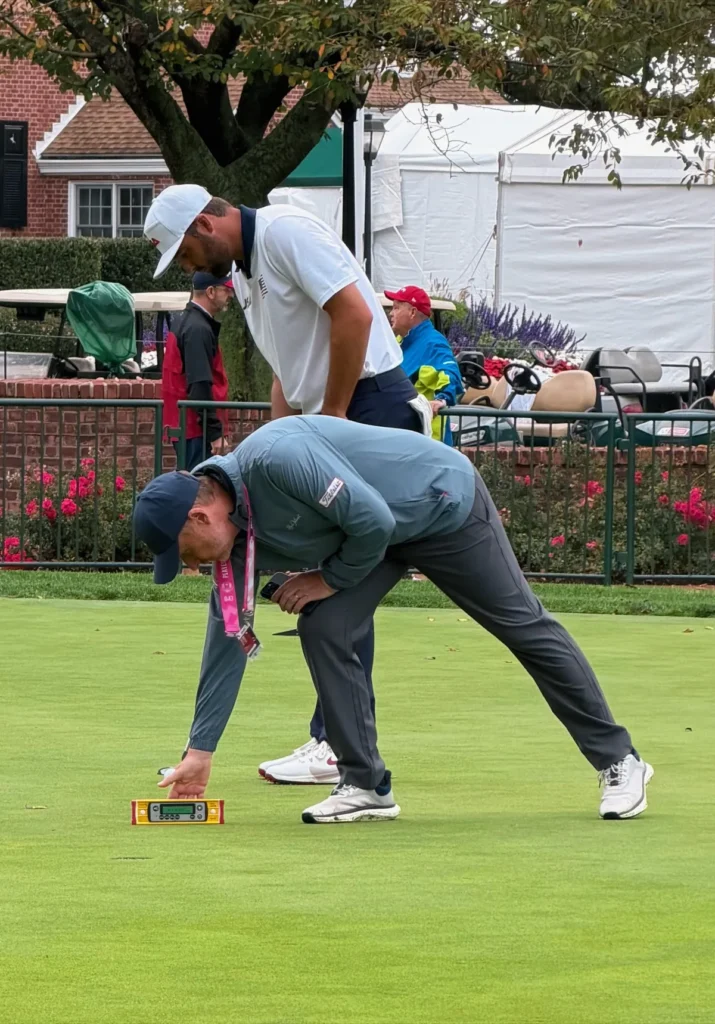
Collin Morikawa’s putting practice was one of the more scientific approaches and centered around calibrating his AimPoint. Morikawa straddled the line of a putt, feeling the amount of slope on the green with this feet. Morikawa’s caddie, Mark Urbanek, used a digital level to measure the actual degree of slope. Urbanek then paced the distance of the putt and calculated the amount of break in inches using the degree of slope and the distance of putt. Urbanek then used a tape measurer to measure that amount of break from the center of the hole, marking that distance outside the hole on the green with a chalk pen, which served as the aim point. Morikawa then went through his full routine and hit the putt.
One such formula to calculate the amount of break in inches is by multiplying the distance of the putt by the degrees of slope divided by two.
Break (in inches) = (Distance in feet) x (Slope %) / 2
This formula gets more complex when you factor in uphill or downhill slope, as a downhill putt will break more than an uphill putt, but on a relatively flat putt with some degree of sideways break it could yield more or less correct results.
While we don’t see a tape measurer used during tournament play, in practice Morikawa and Urbanek are dialing in the feels of Morikawa’s feet and their ability to correctly estimate the slope of the green. They’re getting used to seeing and confirming the amount of break by measuring it exactly, then marking the aim point.
Xander Schauffele
Putter: Odyssey Red Milled Seven X
Practice Aids: String, Putting Plates
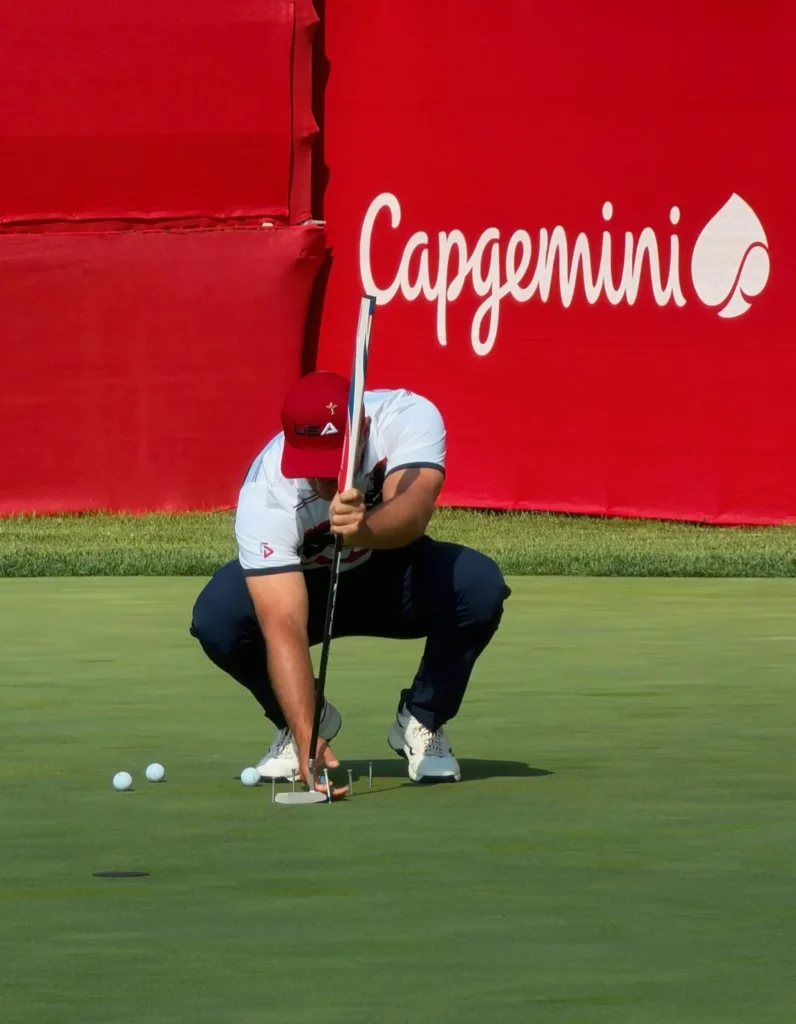
Xander Schauffele had a unique and clever practice routine to check his alignment using string and a Putting Plate. Schauffele would go through his full routine and line up a putt aimed at a tee placed in the ground near the hole. Schauffele then addressed the ball and paused in his set up position while his caddie, Austin Kaiser, removed the golf ball and placed a Putting Plate square to Schauffele’s putter face.

Using string connected to the tee at Schauffele’s aim point near the hole, Kaiser pulled the string taught along the center of the Putting Plate. If the string lined up with the center line of the Putting Plate, Schauffele lined the putt up correctly. If the string line was skew to the center line of the Putting Plate, Schauffele’s alignment was incorrect to his intended line. Kaiser then removed the Putting Plate, put the ball back, and Schauffele hit the putt.
Ben Griffin
Putter: Scotty Cameron Concept 2 Tour (w/ Stainless Steel Insert)
Practice Aids: Tee Putting Gate
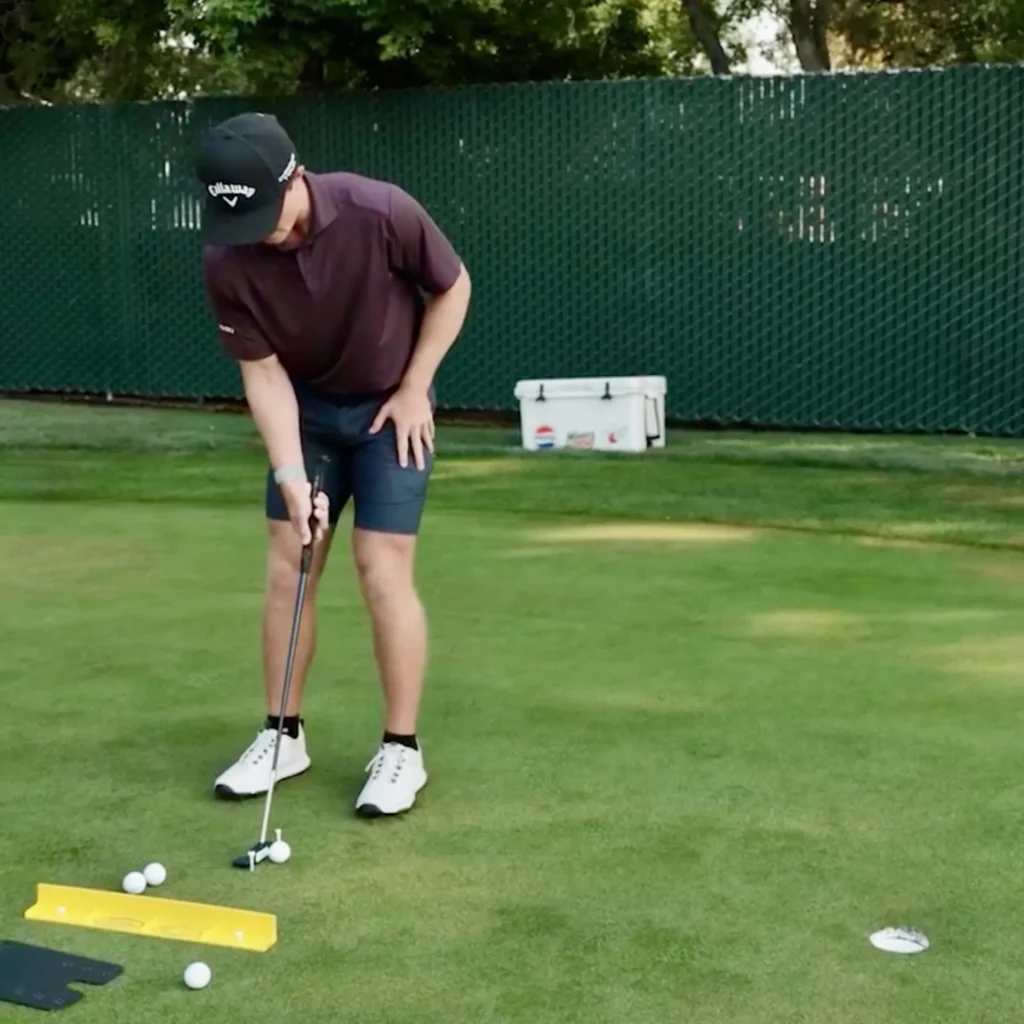
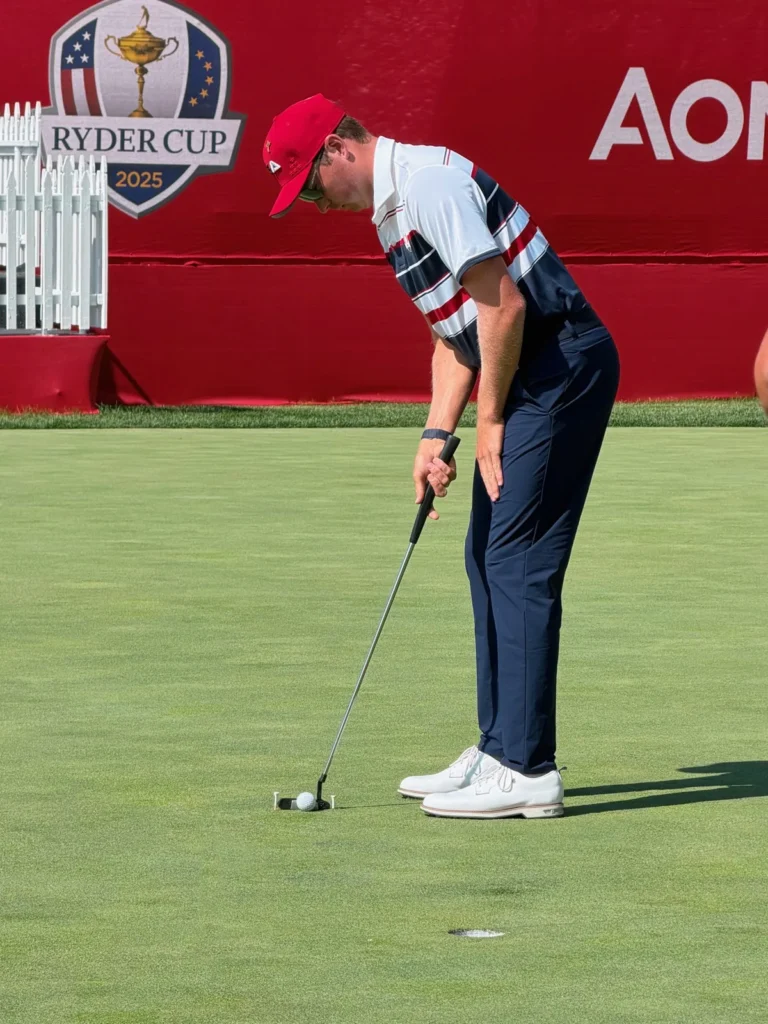
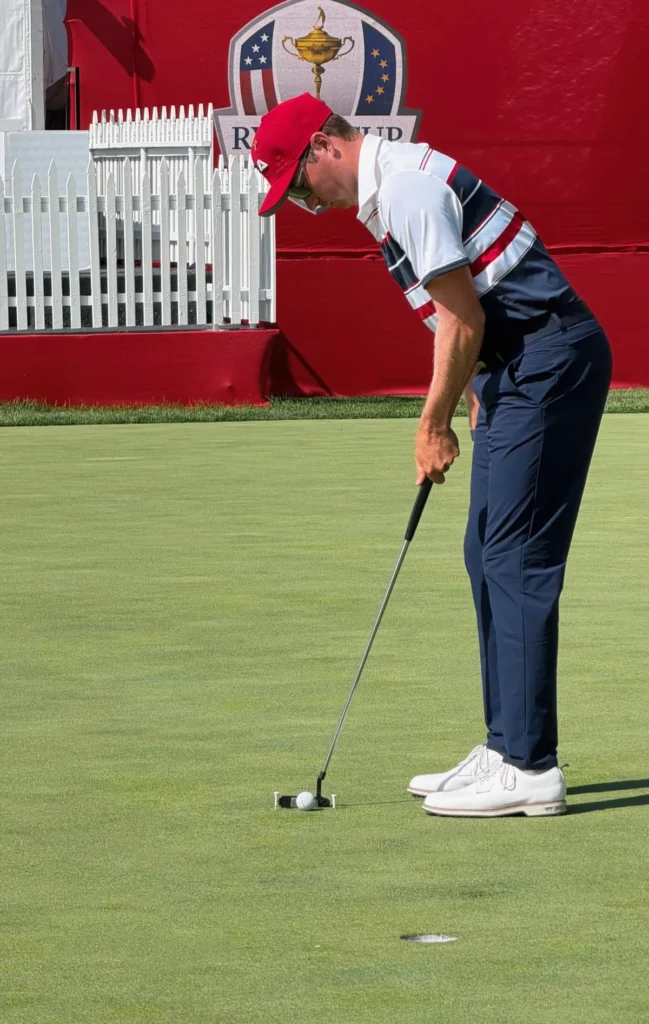
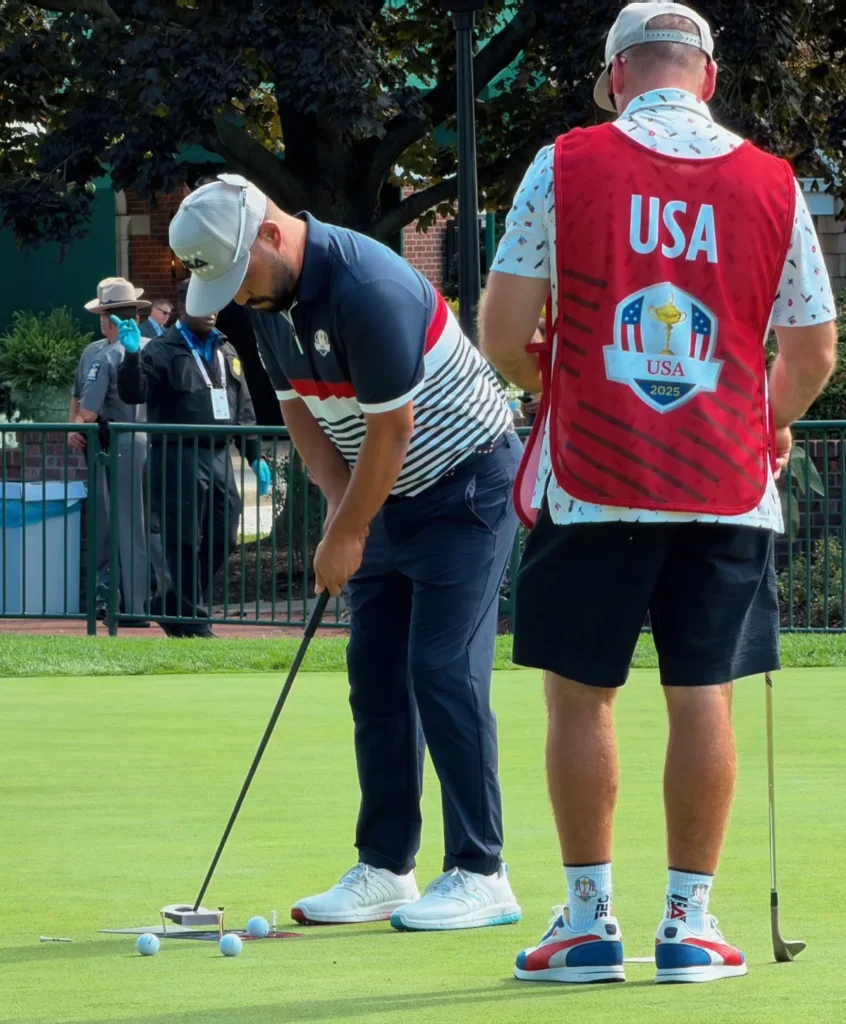
Ben Griffin focused on a consistent center strike and square impact position using a tee placed closely on either side of his putter at address. Griffin hit several four footers using his right hand only, at times with his left hand in his pocket. He then hit putts with his left hand only. After hitting one-handed putts with each hand, Griffin then hit putts with his regular grip.
Tommy Fleetwood
Putter: TaylorMade Spider Tour Black
Practice Aids: Digital Level
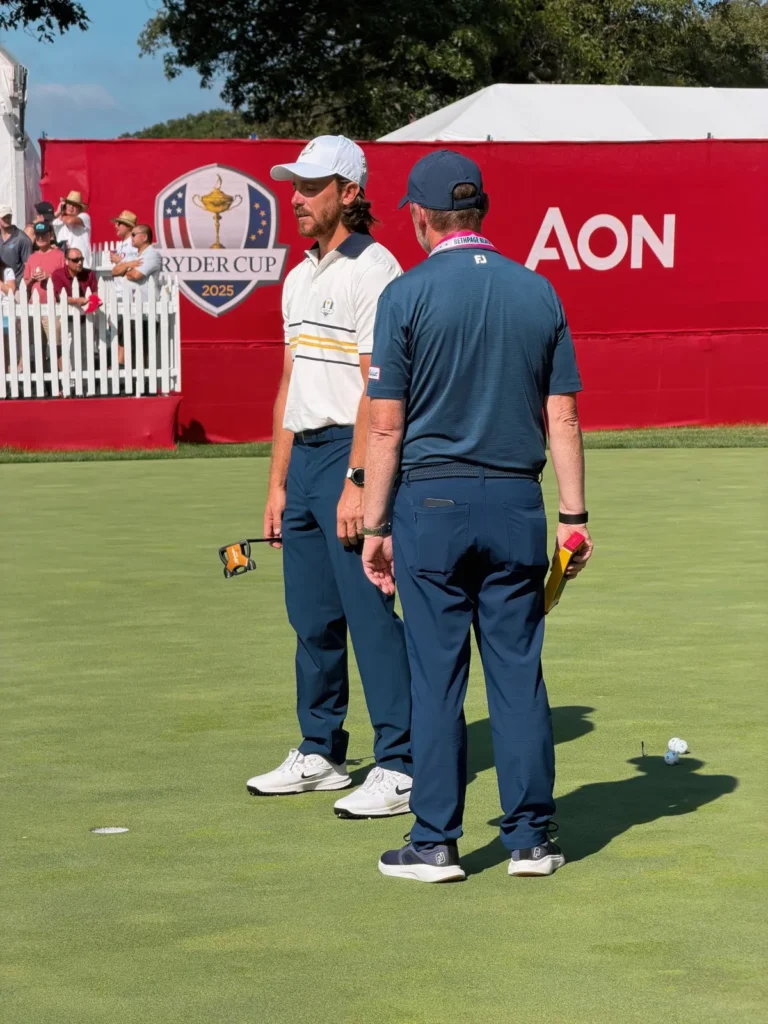
Tommy Fleetwood has been working with Phil Kenyon since 2016 and the pair spent time on the practice green at Bethpage primarily calibrating AimPoint feels on short range putts. Using a digital level, Kenyon measured the slope along the path of five to six foot putts, after which Fleetwood straddled the line to calibrate his feel against the actual slope measurement reading prior to lining up and hitting the putt.
Bryson DeChambeau
Putter: SIK Pro C-Series Armlock
Practice Aids: Tee Putting Gate, Chalk Line
Bryson DeChambeau made a putting gate using six tees and a chalk line marking a straight putt to a putting disk. DeChambeau’s putting stroke is unique in that he uses an arm-lock grip in a very upright setup position and he putts along a truly straight back and straight through path with minimal to no face rotation. Because of this, DeChambeau’s putting gate used the straight chalk line to make a row of three gates in a perfectly straight line where the ball was placed between the middle gate and the back and front gate were used to ensure a center strike on the putter when swinging in a straight back and through path.
DeChambeau also had someone from his team filming his stroke from a down the line angle using an iPhone.

J.J. Spaun
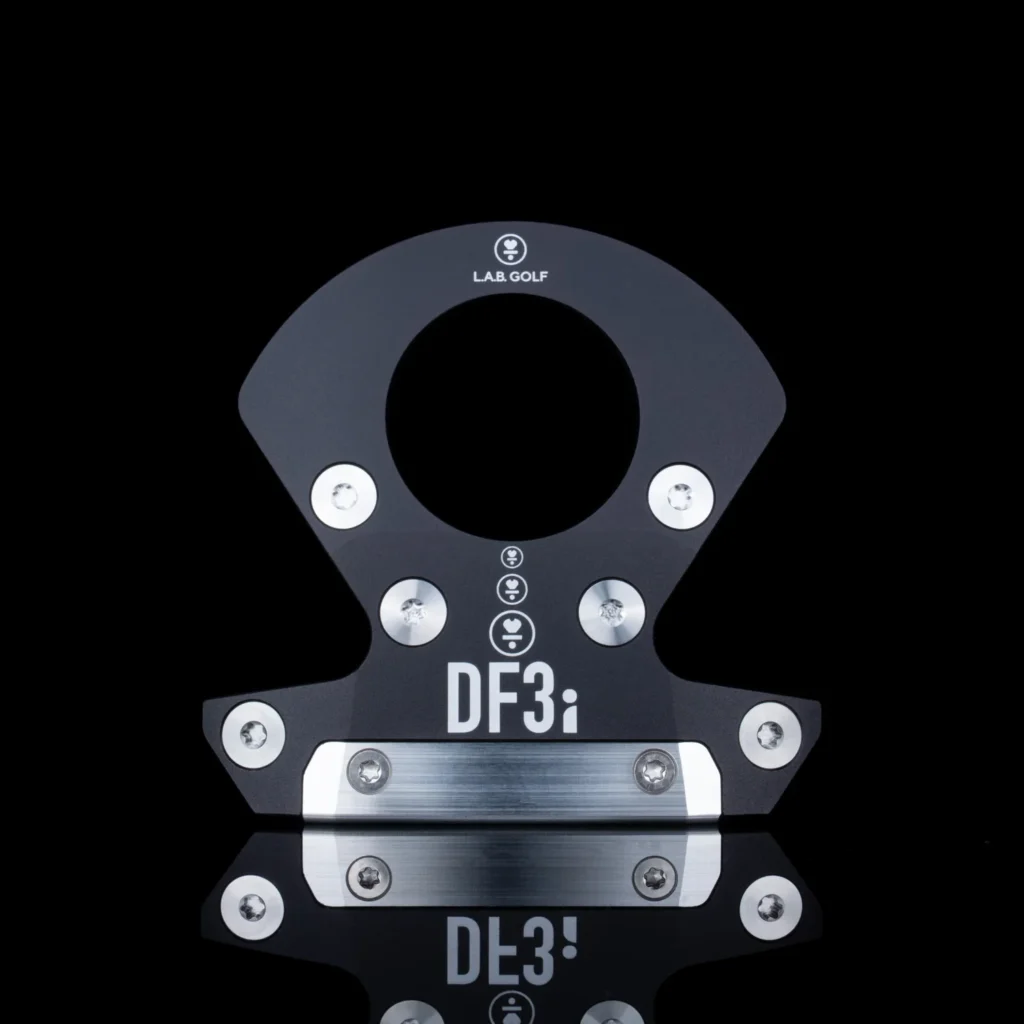
Putter: L.A.B. Golf DF3
Practice Aids: The Putting Arc MS-3D, Putting Mirror
The 2025 U.S. Open winner did block practice to a putting disk around five feet away with a focus on dialing in a correctly arching stroke. Spaun used a Putting Arc MS-3D practice aid placed at the heel of the putter which acts as a template for a mathematically ideal amount of arc for a putting stroke.
Spaun then removed the arc training aid and used a putting mirror at this same distance with a gate set up by placing a tee on either side of the putter at address to dial in a centered impact position at the ball.

Key Takeaways
One tool used by pros that is not often used by amateurs is the putting ramp— likely due to time and money. Putting ramps like those from The Perfect Putter start at $299 which is good for putts up to 15 feet. An extension is required for putts up to 35 feet.

Pros have a caddie or dedicated putting coach that is able to prepare their putting stations ahead of time, allowing them to step in for 20 minutes of high quality practice. If you’re hitting some putts before your 8:06 a.m. tee time at your local course, you’d have to allow extra time to map out your practice station with a putting ramp.
That said, if you’re serious about improving your putting, it is one tool you can add to level up the quality of your putting practice.
A second tool used by pros and not often used by amateurs is a digital level—most likely due to money and the technical learning curve of applying the slope information into practice. The level of choice for Phil Keynon and other players is the Stabila 9 in. IP67 TECH 196 DL Digital Level which costs $248 and trusted for its speed and accuracy, as well as the ability to measure slope in percent and convenient to read display on the top. Where you find a tour pro putting you will find a digital level not far away. Even players like Scottie Scheffler, who use a more traditional green reading style, use a digital level during practice. They leave little guesswork to their putting practice and know exactly what degree of slope they are putting on, even if they don’t use AimPoint.
The most observed training aid used at the Ryder Cup was Visio’s Mi Putting Template 3.0. The template packs a lot of feedback in a small package and gives the player instant awareness of their ability to hit their start line by using a gate made from two tees placed in the template roughly 13 inches in front of the ball. Two more tees placed on either side of the putter at address also trains the players’ ability to achieve a center strike on the putter face.

That said, you don’t need anything more than a couple of tees to make a gate for your putter face like Ben Griffin or Bryson DeChambeau. For additional feedback, place two tees just outside with width of a ball placed a foot in front of your putter head to check your start line for high quality putting practice before your next round.
Whatever your putting practice routine is, the main takeaway is practice with purpose. Practice with intention.
Your Next Read
- The Golf Player’s in-depth review of L.A.B. Golf’s OZ.1i HS.
- Montauk Downs takes a page from Bethpage Black’s playbook in search of becoming one of the top public golf courses in the country.
- Discover Marion Golf Club in Massachusetts, a nine-hole George C. Thomas design blending charm, strategy, and history just miles from Cape Cod.