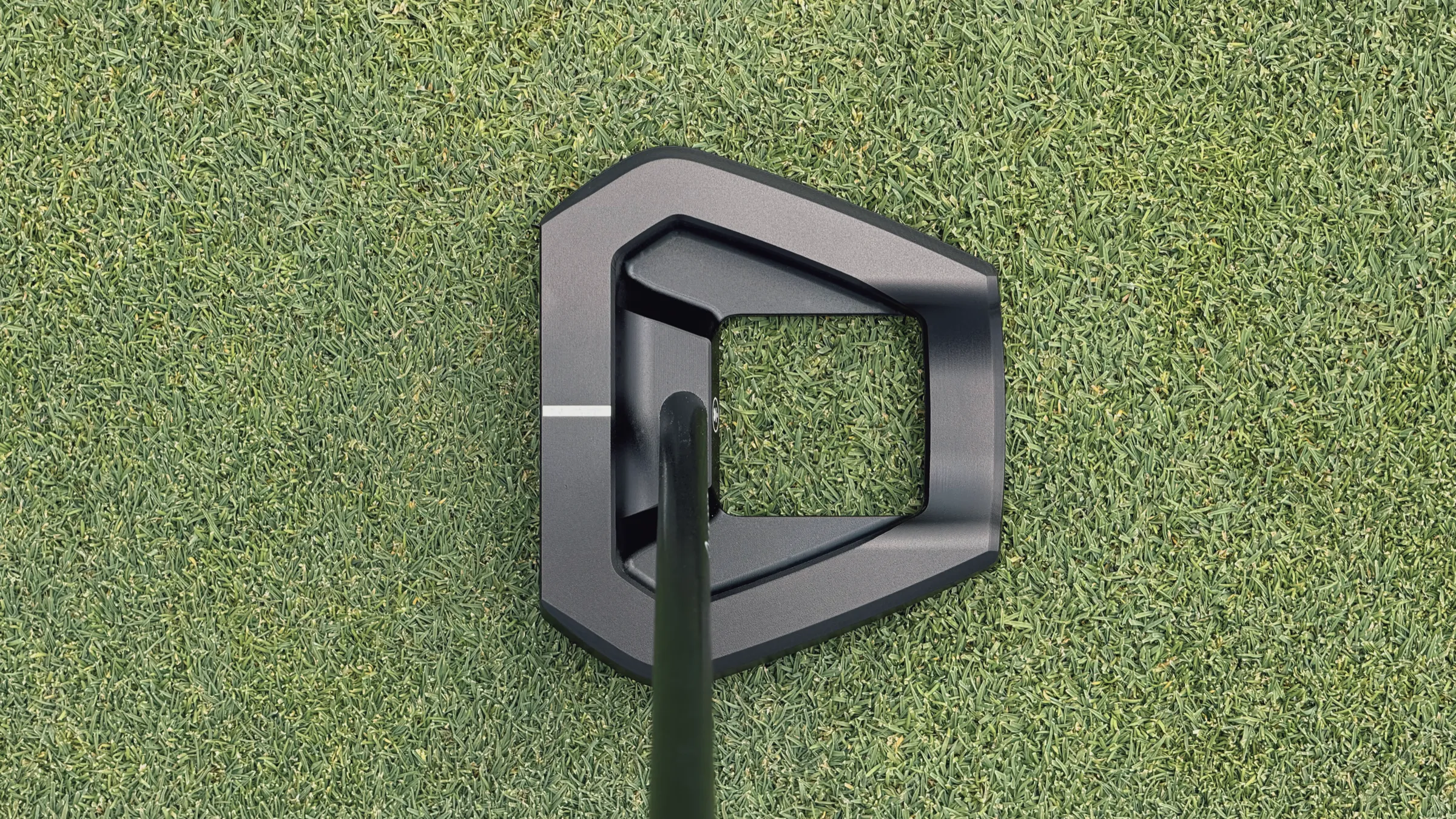
If you’re looking at a L.A.B. putter for the first time, the decision between shaft lean and no shaft lean can raise a lot of questions. Chances are you’ve never had to consider shaft lean as an option on putters you’ve purchased in the past. As a blade putter player for more than 20 years, that’s exactly how I felt. I’d never used a putter with built in shaft lean before, so I didn’t know—do I want it? Does it help? What is standard?
A quick online search didn’t paint a clearer picture either. Some sources make it sound like shaft lean helps promote a more end over end roll on the ball. That sounds pretty good—I want end over end roll, so I should get the shaft lean option, right?
Not necessarily.
To understand which shaft lean option is best for you, it’s important to first understand what role shaft lean plays in the setup, what it affects (and what it doesn’t).
While evaluating the VZN.1i, I got in touch with Cade Stubbs, a Senior Fitting Specialist at L.A.B. Golf. I wanted to better understand how to think about shaft lean, as I had a completely different experience with the VZN.1i with zero degrees of shaft lean compared to OZ.1i HS with 2 degrees of shaft lean.
It turns out I was thinking about shaft lean from the wrong perspective, but the answer is quite straightforward, and in testing both, I’ve now found the option that really clicked for me (hint: it’s also the option that 80% of L.A.B. customers are fit for).
What is Shaft Lean?
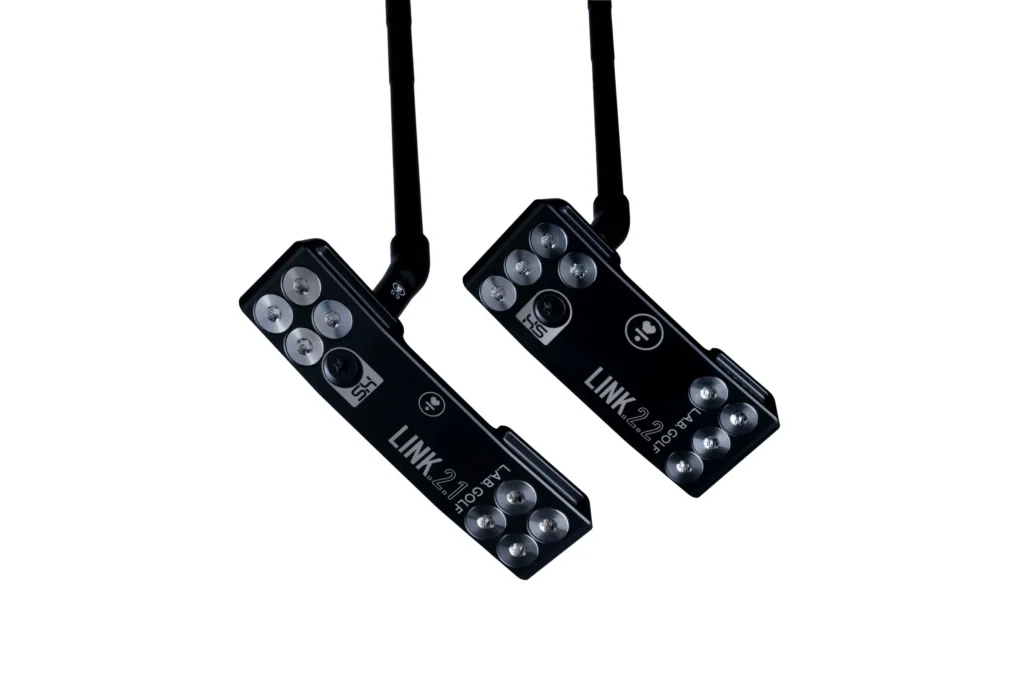
The way L.A.B. gets their putters to balance has to do with where the shaft is inserted into the putter head. Unlike traditional blade putters where the shaft is inserted in front of the putter face (otherwise known as offset), a lie angle balanced putter’s shaft is inserted behind the putter face, or onset.
This creates a situation where the putter would get to the ball ahead of the hands if the shaft were straight. To counter this, the shaft is inserted into the head leaning forward 1.5, 2 or 3 degrees, depending on the putter head’s center of mass. The more onset the shaft to the putter face, the more forward lean the shaft has to have in order to get the grip back in front of the putter face.
This gets the top of the shaft back in front of the putter face, but the slanted shaft can look unusual at address. To make the grip feel square in the player’s hands, L.A.B. pairs these models with its Press grip, which has a built-in forward angle. Although the shaft appears to lean toward the target, the flat surfaces of the grip remain square when held correctly.
Square putter face, slanted shaft, square grip.
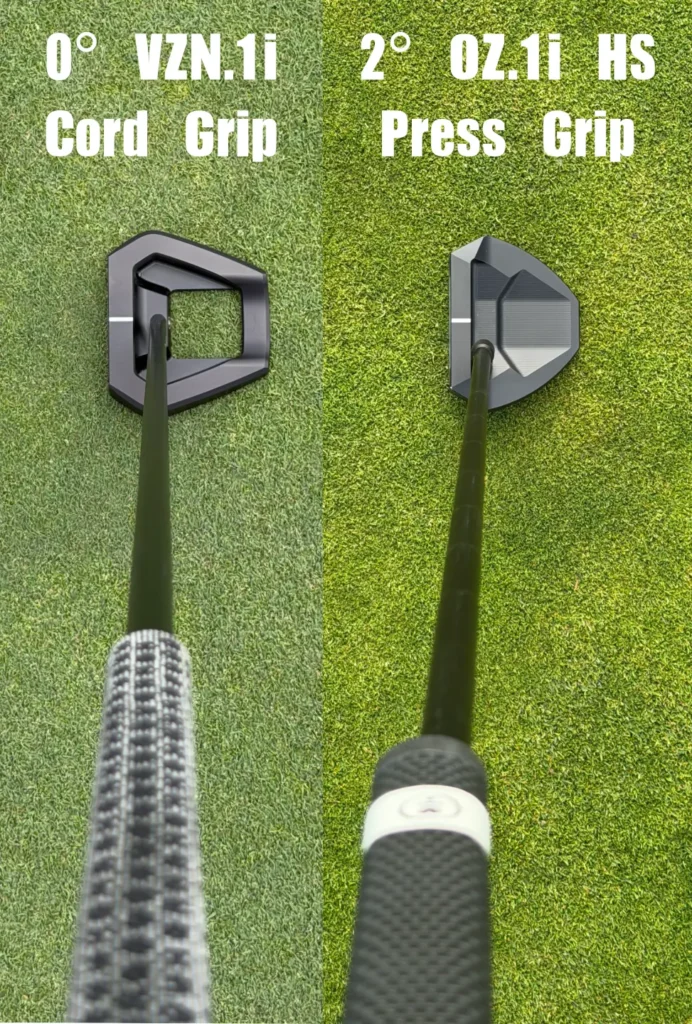
To accommodate normal grips and not the press grip, L.A.B. started introducing putters with zero-degree shaft lean options. Only certain models have both a shaft lean and no shaft lean option:
- OZ.1i
- OZ.1i HS
- VSN.1i
With the zero-degree shaft lean option available, the question becomes, which do you choose? Shaft lean, or no shaft lean?
It’s Not About Visual Preference
I started testing L.A.B. putters last year with the OZ.1i HS. Since it was my first L.A.B. putter, I chose the stock shaft lean configuration. Coming from more than two decades of playing traditional blade putters—starting with a Scotty Cameron Newport Classic back in 1999, all the way up to a Teryllium T22 Newport 2 in 2019—I immediately found the forward-leaning shaft visually unusual.
While my speed control with the OZ.1i HS was excellent, I never felt completely comfortable over shorter putts. I kept wondering if my hands were in the correct position, even though L.A.B.’s design meant I simply needed to grip the putter naturally. It led me to assume that choosing between shaft lean and no shaft lean was largely a matter of visual preference.
When I put that question to Stubbs, his answer was an emphatic “no.”
“Shaft lean should be looked at through a loft, roll, and launch perspective, not a visual preference,” Stubbs explained. “Only if a player has a major visual hindrance to one of the shaft lean options should one or the other be considered.”
What about ball position?
Players inherently have a preference to ball position in their putting setup. Some have it more centered, others have it a little forward or more forward in their stance. Ball position impacts hand position, and while it’s tempting to adjust the ball position to accommodate a putter, you start potentially shifting your ability to perceive what straight looks like when looking down your intended line.
While an adjustment in ball position sometimes is a necessary correction, Stubbs explained he doesn’t want to equate shaft lean with a prescribed ball position. “I would prefer that the ball position doesn’t change so it doesn’t affect your eyeline,” Stubbs explained. “What we want to change is the hand position. More forward press for 2-degree shaft lean models and less forward press for zero-degree options.”
So if ball position doesn’t change, what we’re left with is a difference in hand position. That difference in hand position has a direct impact on roll and launch performance.
Does shaft lean correct a push or pull miss?
If a player’s tendency is a pull side miss, does shaft lean or no shaft lean help correct? Similarly, if the miss is typically a push, would shaft lean or no shaft lean be better?
Not necessarily.
“We look for aim bias,” Stubbs said. “The only consistent trend we see is that shaft lean sometimes gets players to aim left and pull putts. If we see a left miss, we will gear people towards zero degrees of shaft lean. For pushed putts, we will tend to look into other options, non-shaft-lean related.”
So if shaft lean isn’t about visual preference, ball position or correcting a directional miss, what is it actually about?
It’s All About Loft
To understand what shaft lean is really about, Stubbs steered me toward thinking about it in terms of loft and roll conditions. “Shaft lean changes the effective loft of the putter. Shaft lean directly impacts the roll performance for players.”
If I naturally press my hands forward on a zero-degree shaft lean VZN.1i like I might do on a traditional offset blade, does that deloft the putter in a negative way?
Stubbs explained it depends on how much forward press is being applied, but that a small amount is okay or even required to achieve a proper launch angle.
“Think about the putter in terms of loft. The golf ball only knows what loft the golf ball is hit with. Therefore, if we have a VZN1i with zero degrees of shaft lean, we have 2 degrees of effective loft coming from the face loft. So we can press our hands 1 degree forward, meaning 1 degree of loft, and still have an ideal launch angle (between 0.75 and 2 degrees).”
Depending on where the center of mass is, the shaft is inserted at different distances behind the putter face. Different L.A.B. models have different degrees of shaft lean required to get the handle of the grip back in line with the putter face.
“When we have a DF3 with 3 degrees of loft and 2 degrees of shaft lean, we have 5 degrees of effective loft (shaft lean adds to effective loft),” Stubbs continued. “When we have 5 degrees of effective loft, we need 3 degrees of forward press in just your hand position to get back to an ideal launch angle (grips do not inherently change your hand position, so the forward press must come from a player’s hands getting forward).”
This means that even on a model with shaft lean, you can still apply up to one more degree of manual press in your hands and still hit the ideal launch angle of 0.75-2 degrees. “Your hand position should always be neutral or forward, never back,” Stubbs noted.
It’s important to note that shaft lean doesn’t inherently create better end over end roll. It has to work with the player’s individual stroke. For some, having their hands pressed forward helps promote a better roll. For others, the more neutral hand position with zero degrees of shaft lean creates the better aim bias, loft and roll.
What it ultimately comes down to is which option does each individual player aim better with, and which creates the most optimal launch and roll conditions.
These variables aren’t left to guesswork. L.A.B. verifies them using Quintic, a putting analysis system that measures more than 45 parameters of the stroke, including launch and roll characteristics.
When players are fit using that data, a clear trend begins to emerge.
Which Option Does L.A.B. Fit Most Often?
“Almost 80% of our customers fall into the zero-degree option when we use data from Quintic,” Stubbs explained. “We would recommend the zero-degree because it is more traditional.”
What About the Stock Builds?
Interestingly, despite 80% of customers falling into the zero-degree option, the stock build for L.A.B. putters is the option with shaft lean. A zero-degree shaft lean L.A.B. putter, for models that offer it, must be placed as a custom order.
Which Build is More Traditional?
Although the shaft lean build is the stock configuration, the zero-degree option more closely resembles the setup most golfers are already accustomed to. The zero-degree shaft lean allows for more grip options and will feel more natural to players who are used to a neutral hand position and who like to apply a small amount of press, like one would do with a traditional blade or offset mallet putter.
I asked Stubbs if my experience finding the zero-degree shaft lean option on the VZN.1i more natural looking than the OZ.1i HS with shaft lean, coming from a history of playing blades, his answer was, “Yes”.
Turns out, after understanding how L.A.B. thinks about shaft lean, I realized I had been asking the wrong question all along. I wasn’t choosing between two different looks, I was choosing between two different launch conditions. Once I looked at it that way, the zero-degree option ended up being the better fit for my stroke and background using traditional blade putters.
Final thoughts
- Think of shaft lean in terms of loft, roll and launch perspective, not purely about visuals.
- If you have a L.A.B. shaft lean model, or have tried one, and were seeing a consistent left miss, it might be that zero-degrees of shaft lean is better suited for your setup and stroke.
- If you’re coming from a traditional blade or offset mallet, it’s worth testing the zero-degree option alongside the shaft lean build.
- If you’re unsure about which shaft lean option to pick, Stubbs suggests players get fitted, either in person or using L.A.B.’s remote fitting—a free online service where L.A.B. fitting professionals analyze a face-on video of your putting stroke to determine your ideal putter specifications, including shaft lean.