Some of the products featured in this review use affiliate links, meaning The Golf Player may earn a small commission if you make a purchase.
2025 was a breakout year for L.A.B. Golf. J.J. Spaun’s miraculous 64-foot putt on the 72nd hole to win the 2025 U.S. Open didn’t just secure a major championship—it thrust L.A.B. Golf into the mainstream. As the putt dropped, Spaun tossed his putter skyward in celebration, creating a now-iconic image of his L.A.B. DF3 suspended mid-air. It marked the first major championship victory with a L.A.B. putter and instantly sparked the same question among golfers everywhere: What is that funny-looking putter?
L.A.B. has never shied away from that reaction. The brand’s designs are unapologetically unconventional, prioritizing lie angle balance and performance over traditional aesthetics. For years, that commitment to function-first engineering has intrigued curious golfers while simultaneously turning others away.
As a lifelong blade putter player, I was interested in L.A.B.’s technology, but with the brand historically focused on center-shafted designs, it seemed like too much of a departure to put a L.A.B. putter in the bag.
That is, until the release of the OZ.1i HS, a heel-shafted take on the company’s most approachable head shape to date.
Review Methodology
Great putting relies on three factors: proper green reading, the ability to start the ball on the intended line, and matching that line with the correct speed.
While no putter can correct a bad read, it can influence start line and speed control. With that in mind, here’s what I was looking for from the OZ.1i HS:
- Stability at address
- Strong alignment cues
- Consistency with lag putting
- Confidence in the critical 3-7 foot range
Did the OZ.1i HS deliver? To answer that, it’s important to first understand the technology that defines every L.A.B. putter—lie angle balance—before diving into the specifics of the OZ.1i HS and how it performs on the course.
What Is Lie Angle Balance?
Lie angle balance is a weighting profile for a putter whereby the clubface stays square when the putter is set on its lie angle. Lie angle balance is often associated with a significantly reduced torque profile compared to toe-hang putters.
Torque, as explained by renowned PGA putting coach, Phil Kenyon, “is the potential for a club to twist when we move it.” The amount of potential twist a putter may have depends on the relationship between the axis of the shaft and the center of gravity of the putter head.
In a lie angle balanced putter, the center of gravity of the head is aligned with the shaft’s lie plane so that, when the putter is set to its specific lie angle, the head naturally wants to stay square, resisting face twist, or torque, during the stroke.
It is important to make the observation that torque is inherently neither good nor bad. The potential for a putter head to twist offers feedback to the golfer and provides awareness of where the club head is in space during the stroke. “A lot of golfers need torque in order to be able to coordinate and control the face,” Kenyon further explains. “It can help for many golfers in terms of face awareness.”
What matters isn’t how much torque a putter has, or whether less torque is “better,” but whether the torque profile matches the golfer’s stroke and helps start the ball on line more often than not.
All of L.A.B. Golf’s putters are meticulously hand-balanced to their specific lie angle at L.A.B.’s manufacturing plant in Creswell, Oregon, including the OZ.1i HS.
What Is the L.A.B. OZ.1i HS?
The original OZ.1i is a tour-inspired half-moon mallet designed in 2023 by L.A.B. Golf with input from 14-time PGA Tour winner Adam Scott. First released in late 2024 with a stainless steel insert—the “i” in the name standing for insert—the OZ.1i was later offered in an all-aluminum, no-insert version in January 2025. By L.A.B.’s own admission, it is the most “normal”-looking mallet the company has ever produced.
In late August 2025, L.A.B. introduced the OZ.1i HS, the company’s first-ever heel-shafted offering and third variation on the OZ.1 design. The heel-shafted design is made possible by L.A.B.’s proprietary hosel mechanism, or “riser” as L.A.B. calls it.
“The reason it’s called a riser is that as the lie angle goes from our lowest lie angle of 65 degrees to our highest lie angle of 74 degrees the riser gets taller in order to keep the shaft axis in a very specific location to function with our lie angle balance process,” explains Brian Parks, VP of Engineering at L.A.B. Golf.
To maintain 100 percent lie angle balance despite the shaft connecting at the heel, the riser is constructed from lightweight aluminum rather than stainless steel, which would add unwanted mass in a critical area. It’s a thoughtful and technically elegant solution, one that underscores the level of engineering and craftsmanship behind L.A.B.’s designs.
Design & Aesthetics
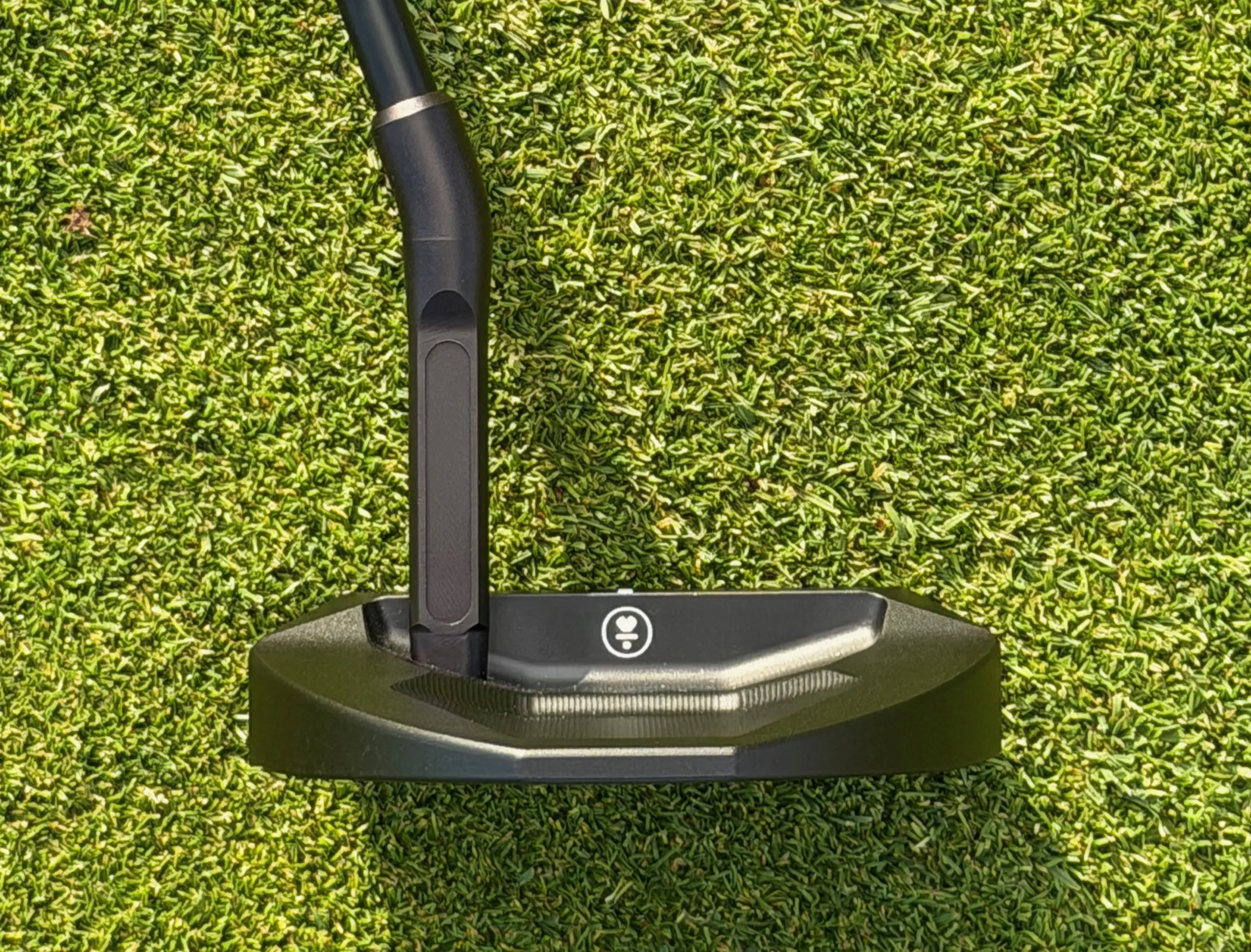
The OZ.1i HS is a mid-size mallet with a half-inch-thick topline and a half-moon back that sits like a true mallet as opposed to a blade with added mass behind it. It shares the same aluminum body and fly-milled stainless steel insert as the center shafted OZ.1i, with the key distinction being the shaft’s placement at the heel rather than the center of the face.
Its faceted appearance and sharp angles give the putter a modern, slightly futuristic look, an aesthetic that Adam Scott has said was inspired by the timeless design language of Porsche and Rolex. At address, the OZ.1i HS manages to feel substantial without looking bulky, striking a balance between modern design and the scientific constraints required to achieve lie angle balance.
Even though the OZ.1i HS soles like a more traditional heel shafted mallet, a noticeable difference is that the shaft is onset to the putter face, meaning it enters the head behind the face rather than in front of it. This differs from many traditional mallet putters, which more commonly feature offset shafts positioned ahead of the face. In the stock configuration, L.A.B. addresses this onset by building the putter with two degrees of forward shaft lean paired with a press grip, which places the grip slightly ahead of the face at address. The forward leaning shaft looks odd at first coming from a traditional blade, but becomes more natural over time.
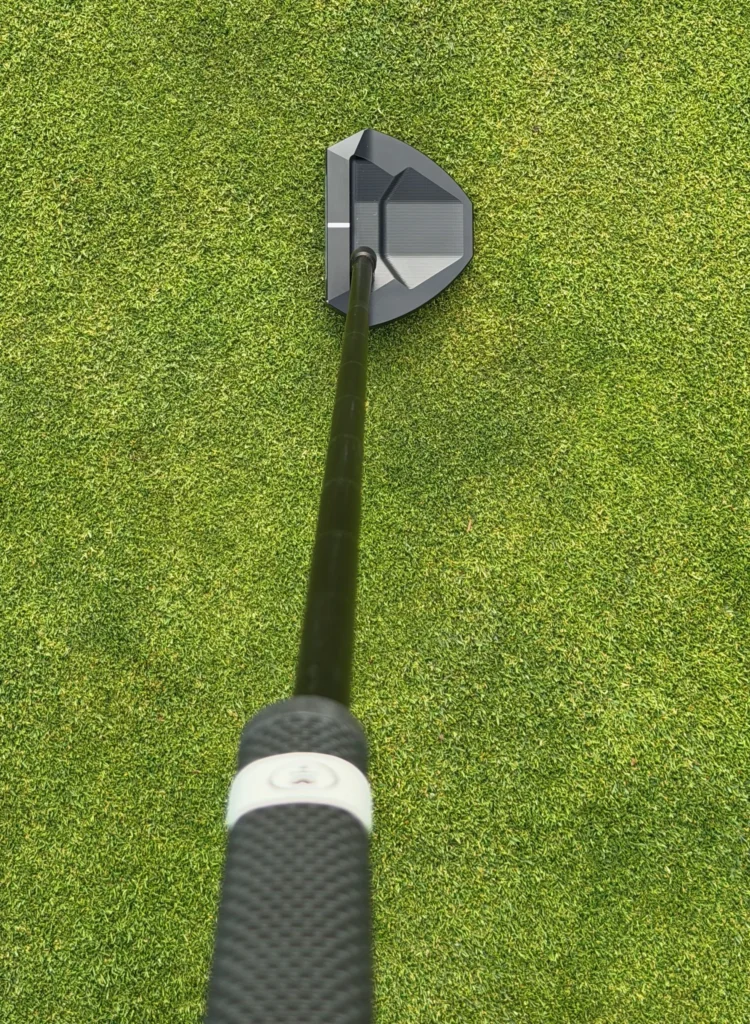
Unique to the heel-shafted OZ.1i is the option for zero degrees of vertical shaft lean. This creates a more traditional look at address and allows players to use any standard putting grip rather than L.A.B.’s Press grip.
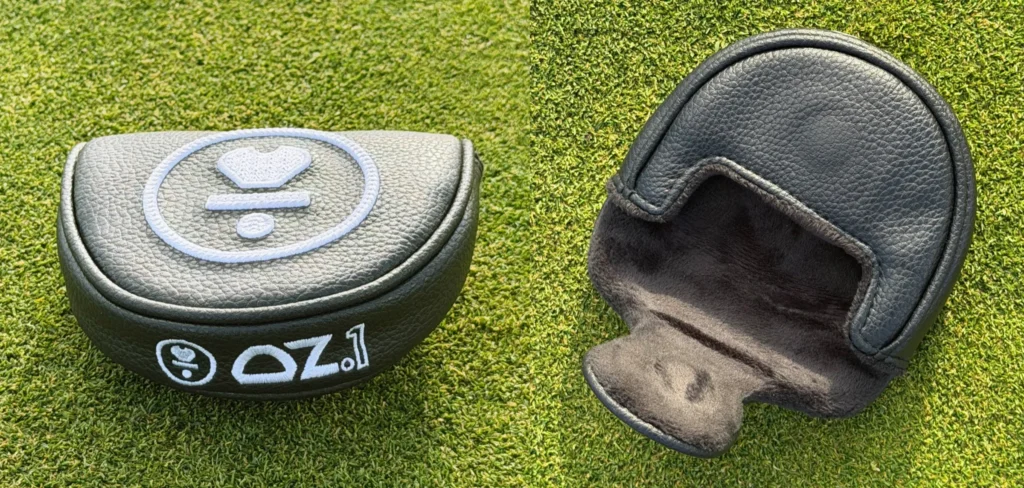
The putter comes with a premium leather headcover that secures by a magnetic closure—a welcome upgrade over Velcro. What I liked about the magnetic closure is the ability to silently take the putter out of the headcover while someone else in the group is hitting or putting.
Alignment Cues
Proper alignment of the putter head is a critical part to starting the ball on its intended line. The half-moon shape of the OZ.1i HS has alignment cues built into its core design to help make alignment more intuitive.
The solid one-piece construction of the OZ.1i HS features a triangular topline, a design element that Adam Scott and the L.A.B. team incorporated from L.A.B.’s Mezz.1 Max putter.
The sharp angles created by the triangular topline on the toe and heel converge 2.75 inches in front of the face, which—combined with the flat channel on the flange—creates a phantom arrow that points down the intended start line.
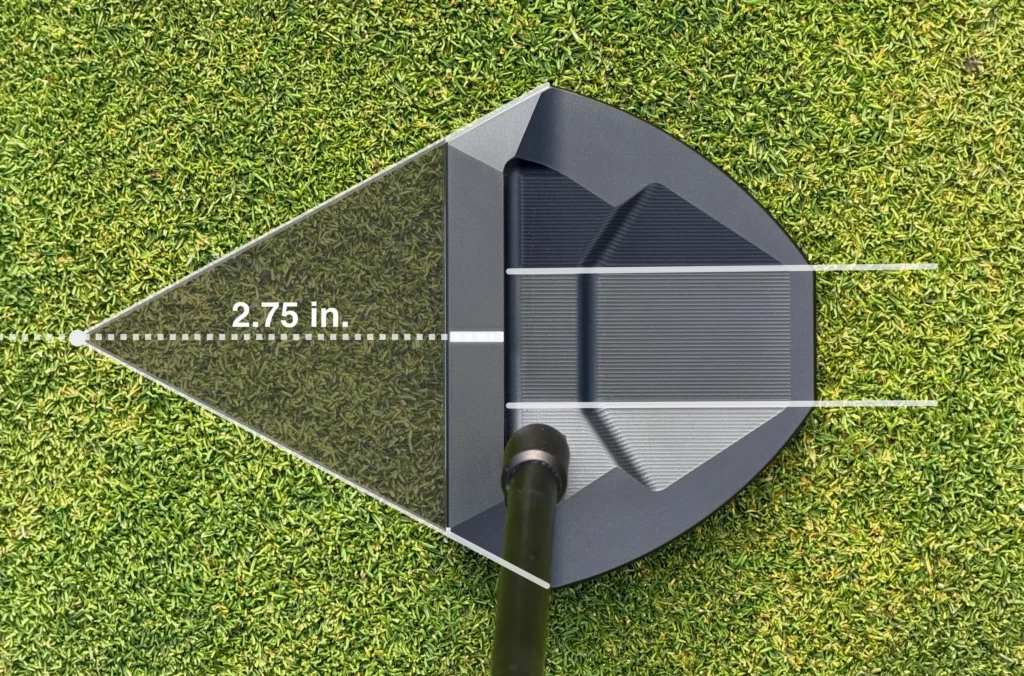
In additional to the physical alignment cues, the OZ.1i HS can be customized with 32 alignment mark options on the top and 22 alignment mark options on the flange so players can be extremely specific with the alignment marks that inspire confidence for them.
Since the shaft inserts into the heel of the putter, the OZ.1i HS allows for alignment lines that run continuous along the entire length of the flange.
Consistency with Lag Putting
The first round I took the L.A.B. OZ.1i HS on the course I made the very first putt— a downhill breaking 27-footer from the back fringe for birdie on Bethpage Red.
The stainless steel insert gives the OZ.1i HS a firmer, more responsive feel than I’m used to. Impact produces a slightly hotter sensation off the face, translating to faster ball speeds and a crisp, affirming “thump” sound—particularly pleasing on longer putts where I quickly found consistency with my distance control.
I had the OZ.1i HS in the bag for my round at Marion Golf Club where I had similar results with putts outside of 20 feet. My lag putting was very consistent, which gave me a lot of confidence in my approach game knowing that I just needed it get it anywhere on the green and I’d have a real chance of making it, or, at worst, a no-stress two putt.
While I was scaring the hole on many 15-30 foot putts where the make rate statistically is relatively low, where I struggled with the OZ.1i HS was on putts I had more of an expectation to make: those inside seven feet.
The Critical 3-7 Foot Range
Mark Broadie’s book, Every Shot Counts, reveals that the most important putt according to strokes gained is five feet, followed by four and six feet. According to Broadie’s research, putts from three to seven feet account for 38% of total strokes gained on the PGA Tour. Needless to say, the 3-7 foot range is crucial to playing great golf.
Using the OZ.1i HS, I initially struggled in this critical range. To my eye, the OZ.1i HS appeared slightly closed at address using my normal setup and grip. A slight adjustment of moving my hands forward at address corrected the face feeling closed, but I found myself constantly checking if my hands were in the right position with the two degrees of shaft lean and press grip looking foreign to me at setup.
What I might have been experiencing here is what L.A.B. Co-Founder, Sam Hahn, calls a “torque hangover.” This is where the tendencies and muscle memory you ingrained with your non-L.A.B. putter to set up square and swing the putter carry over to a L.A.B. putter, which is weighted to automatically sole square and swing square without additional manipulation from the golfer.
“When you take the torque away, things can feel really vague and strange at first, and you don’t kind of feel at first that you know where the putter is, and some people struggle,” Hahn explains. In prescribing how to get past a torque hangover Hahn suggests first checking alignment; It’s possible I had been subconsciously aiming slightly left with my blade putter, with the putter face slightly open to compensate. When setting up with the OZ.1i the same way, but with a now square putter face, it looks closed, and the ball would start left of my intended line.
Knowing there’s a term for these initial struggles was reassuring and suggested that any frustrations I felt were part of the adjustment process, not a flaw in the putter.
The more rounds I played with the OZ.1i HS the more comfortable I felt with it and my 3-7 footers did improve, but it required some exploration with my setup, ball position and grip—even trying a Justin Rose-style claw grip which was actually quite successful.
I did not get fitted for my OZ.1i HS and it’s possible the zero degree shaft lean option would suit my eye better. The beauty with L.A.B. is they offer a wide range of customization options to tailor the look and feel of the OZ.1i HS so it best suits each individual golfer.
Price, Customization & Value
The L.A.B. OZ.1i HS starts at $499 for its stock configuration, which comes in a 69 degree lie angle, matte black head and premium steel shaft with 2 degrees of shaft lean and Press Pistol grip. The stock configuration comes in 33, 34 or 35 inch length options.
For any lie angle other than 69 degrees or to further customize the putter is considered a custom order, which starts at $599. The custom configuration opens up additional modifications such as changing the putter head color, choosing one of three head weight options of (standard, heavier or lighter), a zero shaft lean option, which allows for the use of any grip, as well as custom alignment marks and various grip options.
Custom shaft options carry an additional charge on top of the base customization price ranging from +$100-$399, depending on the shaft.
The custom order can accommodate a wider range of shaft lengths and lie angles compared to the stock configuration, including 28-36 inch length options and lie angles from 65 to 74 degrees.
All said and done, a L.A.B. OZ.1i HS ranges from $499-1022.99, depending on the level of customization and before the cost of an in person fitting, which falls between $125-250 at L.A.B.’s headquarters in Creswell Oregon.
During a Q&A on L.A.B.’s YouTube account, L.A.B. Co-Founder Sam Hahn addressed the question of price and explained the high price is mainly due to two reasons: labor and manufacturing costs.
“If I had to guess, I would say our labor cost per putter is probably close to 10 times what it is for our competitors,” Hahn explains. “We have yet to find an overseas manufacturer that can meet our tolerances. In order to get these things to balance the way that we need them to balance the components have to be perfect or as close to perfect as the machining world will allow. To that end, all of the major components of our putters are made right here in the United States.”
Who the L.A.B. OZ1.i HS is for
- Players who prefer a more conventional putter design and seek modern lie angle balance technology to help stabilize the putter throughout the stroke.
- Players who value a heel-shafted putter, which allows for a clean topline for an alignment aid that goes across the entire top of the putter or just having the topline unobstructed by the shaft
- Players who value customization— the OZ.1i HS offers custom configuration options that far exceed what other manufacturers offer. With multiple color options for the putter head, three weighting options, two shaft lean configurations, 32 alignment mark options on the top and 22 alignment mark options on the back, as well as various grip and shaft upgrades—its paradise for players who like customizing every facet of their equipment.
Who the L.A.B. OZ1.i HS is not for
- Players who like to feel more of a flow to their putting stroke and a sensation of releasing the toe through impact may find the OZ.1i HS feels too neutral in motion.
- Players looking to switch out their current putter and expecting immediate results from the lie angle balance technology may become frustrated if they experience a “torque hangover”. Even though the OZ.1i HS is balanced to the lie angle, it’s still easy to manipulate the face in a negative way and the fundamentals you’ve engrained with your previous putter may not translate immediately to the OZ.1i HS.
All of this is not to say the results won’t come, they just might not be seen immediately, and may require some adjustment to get there.
L.A.B. putters are unique. They look different. They work different.
Lie angle balance technology can be a phenomenal tool to help golfers more easily swing the putter and present the club face square face at impact—but it’s not automatic. It’s why J.J. Spaun practices with a putting arc to check that his path is consistent, repeatable and swinging along his intended arc, even with his lie angle balanced DF3.
Even though the OZ.1i HS is a more familiar looking heel-shafted mallet, there are aspects of it that will be foreign to players coming from a non-L.A.B. putter. It’s possible the only thing the OZ.1i HS has in common with your previous putter is the fact it is heel-shafted and if you aren’t willing to put in the time to adjust, learn, tweak, you might be disappointed with this purchase.
Pros & Cons
Pros
- Exceptional face stability with L.A.B.’s hand balanced weighting technology
- More traditional mallet shape compared to other L.A.B. models
- Heel-shafted design for a more familiar look and unobstructed topline
- Consistent roll and forgiveness on off-center strikes
- Appealing all black design (head, shaft and grip) included in stock configuration
- Major components made and assembled in the United States
Cons
- Custom fitting required for best results
- Shaft lean option may be unfamiliar to traditionalists at first
- May require adjustment period to learn how to let the putter work for you
- Aluminum riser is softer metal, which shows wear more easily
Final Verdict
There is no single correct approach to putting; it’s an aspect of the game shaped as much by feel and intuition as by technique and mechanics.
How a putter looks and feels at address and the confidence it inspires while standing over a putt matter just as much as the technology built into it. Performance only works if the player is inspired by and willing to trust what they’re holding.
That’s where the OZ.1i HS distinguishes itself. The OZ.1i HS delivers exceptional face stability and speed control, paired with alignment cues that make it easier to visualize and commit to a start line. The consistency it provides—particularly on longer putts—builds confidence quickly.
The heel-shafted design addresses many of the visual hurdles golfers may have had with L.A.B.’s initial designs, offering a more familiar look without abandoning the principles of lie angle balance.
The question, then, isn’t whether lie angle balance works; it does. But it might require subtle adjustments to a player’s ingrained habits, and it’s not for everyone.
What ultimately matters is fit, matching a putter’s characteristics to a golfer’s natural motion in a way that helps them start the ball on line more often. For players seeking modern putting performance without sacrificing aesthetics, the OZ.1i HS may be L.A.B. Golf’s most compelling offering yet.
Why Trust This Review
This review is based on extended, real-world use—not initial reactions from hitting a couple of putts on a practice green. I tested the L.A.B. OZ.1i HS over several months, practicing with it and playing rounds of golf across different courses in both New York and Los Angeles. These rounds included varying green speeds, turf conditions, and travel, all of which reveal things you simply can’t learn in a day.
I also come to this putter from the perspective of a competitive amateur. I played NCAA Division II golf at Chico State and currently carry a +0.7 handicap at the time of writing. In 2025, I qualified for the MGA Public Links Championship, placing sixth in qualifying. While I’m nowhere near a professional golfer, I’m a serious player actively working with my lifelong swing coach to improve while continually evaluating my game in search of lower scores.