It’s that time of year again. Applications for the 2027 Masters ticket lottery are now open, and for thousands of golfers and fans alike—hope springs eternal. The chance to walk Augusta National during Masters week remains one of the most coveted tickets in sports, yet the process for obtaining those tickets remains one of golf’s enduring mysteries.
The application itself is straightforward enough. Augusta National allows one application per household. Applicants may request up to four tickets for practice rounds and up to two tickets for tournament rounds. You can select multiple days, but if your household is chosen, you can only win tickets for one day.
And that’s about where the public information ends.
Since the online application system began in 2012, Augusta National has treated the mechanics of the Masters ticket lottery like a closely guarded secret. We know the rules. We know the chances are slim. But we don’t know how winners are actually selected.
That uncertainty has led to plenty of theories to surface over the years. Some applicants believe first-time entrants receive preference. Others suspect households that have gone years without winning gradually receive better odds. There are even theories that Augusta National balances winners geographically to ensure representation from across the country and around the world. Spend enough time on golf forums and you’ll find no shortage of explanations from people convinced they’ve cracked the code.
The truth is nobody outside Augusta National knows.
So I asked four AI models—ChatGPT, Claude, Gemini and Grok—to analyze the known facts and estimate the most likely lottery design. I gave each model the same prompt and asked them to make their best inference based on lottery design, probability and fairness principles.
What surprised me was that three of the four models arrived at essentially the same conclusion, and their answer changed how I think about applying.
The Theory: Households First, Days Second
ChatGPT, Gemini and Grok all independently landed on a variation of the same idea: Augusta National likely selects households first and assigns days second.
Under this theory, your household isn’t entered into separate lotteries for Tuesday, Wednesday, Thursday and Sunday. Instead, your household is entered into the lottery once. If your household is selected, Augusta National then determines which of your requested days receives tickets based on whatever inventory and allocation rules exist behind the scenes.
The logic is compelling because it neatly satisfies every publicly known rule. The one-household limit suggests the household is the primary unit being randomized. The one-day-only restriction becomes easy to enforce because once a household wins, the household is simply removed from the process. The system also avoids the complexity of running separate lotteries for each day and then removing duplicate winners afterward.
Grok described it as the cleanest solution because it satisfies all known constraints without requiring additional layers of bookkeeping or undisclosed priority systems.
Of course, none of this proves that Augusta National actually conducts the lottery this way. But three different AI models analyzing the same problem independently arrived at essentially the same answer, which makes the theory highly compelling.
Claude was the lone outlier. While it also favored a household-first system, it suggested Augusta National could potentially add weighting for applicants who have gone multiple years without winning. The idea would gradually improve the odds for persistent applicants while still maintaining a random draw. It’s an intriguing theory, though unlike the household-first model, the other AI systems did not independently arrive at the same conclusion.
If They’re Right, It Changes Everything
The most interesting part of the exercise wasn’t the theory itself. It was the implication for applicants.
Many people approach the Masters lottery as though every day selected represents another chance to win. Under the household-first theory, that’s probably not what’s happening.
Instead, your day selections function more like a preference sheet. You’re telling Augusta National which days you would be willing to attend if your household is selected.
That creates an interesting strategic question.
If you only select Sunday, you’re maximizing the chance that, if selected, you’ll receive the exact day you want. But you’re also limiting Augusta National’s flexibility. If Sunday’s inventory has already been exhausted by the time your household is drawn, you won’t get Sunday tickets, and since you didn’t apply for any other days, you’re out.
If, however, you’ve selected Wednesday, Thursday, Saturday and Sunday, Augusta National has multiple opportunities to fulfill your request after your household has already been drawn, as inventory allows.
Viewed through that lens, selecting more days isn’t necessarily increasing your chances of winning the lottery. It’s increasing the number of acceptable outcomes after you’ve already won.
That’s a very different way of thinking about the application.
How I’m Applying
Assuming the household-first theory is correct—and again, none of us actually know—I’m approaching the application differently than I have in previous years.
Rather than checking every box available, I’m treating the application as a list of days I’m genuinely willing to attend.
A Masters trip is about more than simply obtaining a ticket. There are flights to book, hotels to reserve, days off of work to request and expectations for the experience you want to have once you arrive.
For some, the ideal Masters experience is tournament play. They want to see meaningful competition, experience the Sunday pressure and the possibility of watching history unfold in person.
For others, the practice rounds may actually be the better experience. Practice round lottery winners can purchase up to four tickets, making it possible for an entire family to walk the grounds of Augusta National together, visit the merchandise shop and then spend the weekend watching the tournament unfold from the comfort of their home. Unlike tournament days, you can take photographs for personal use during practice rounds (although not on a cell phone, which are prohibited at all times), which makes Monday-Wednesday very appealing days to attend.
This is the angle I’m taking. I would rather go to a practice round with my family, take some pictures, hopefully pick up a gnome, walk Augusta National, and then watch the tournament from home. So I am applying for four tickets for Monday through Wednesday practice rounds only—no tournament days.
If watching tournament golf is what matters most to you, only apply for Thursday through Sunday tickets. Likewise, if a Wednesday practice round with family sounds like your dream Masters experience, don’t overlook it because you won’t get a glimpse of a player slipping on the green jacket.
The more I thought about the AI models’ answers, the more the application began to feel less like entering multiple lotteries and more like answering a simple question:
If your household gets selected, which Masters experience do you want?
And request your tickets accordingly.
The 2027 Masters tickets applications are open now through June 20, 2026.
For many golfers, the first club ever put in their hands came from Dad.
Maybe it was a plastic putter and a giant Wiffle ball rolling across the living room carpet. Maybe it was a cut-down 7-iron and an afternoon bucket at the range or a few holes on an executive par-3 course where the moments between shots are more important than par.
For golf broadcaster, podcaster, and author Shane Bacon, the moments that stick the most aren’t necessarily tied to a swing or a scorecard. Bacon, a father of two, says his favorite memories are often the simplest ones: a golf cart, an afternoon outside and his family along for the ride.
“Taking the family out to the golf course will always be my favorite,” Bacon told The Golf Player. “Four of us packed into one golf cart driving around just enjoying the afternoon and playing a very limited amount of golf. Those are the memories I cherish the most.”
Shane Bacon spends time on the golf course with his children as part of Mack Weldon’s Father’s Day campaign Growing the Game. Image courtesy of Mack Weldon and Shane Bacon.
There is something about golf that creates a special kind of connection between fathers and their children. Sometimes it’s playing together. Sometimes it’s watching a golf tournament on TV, or comparing notes after separate rounds played a few states apart. And sometimes it’s just spending a couple of hours together on a golf course with nowhere else to be. It’s a sport that inspires togetherness and conversation in so many ways.
Bacon sees it the same way.
“I think parents love it when their kids love what they love,” he said. “Maybe it’s golf or their favorite baseball team or a certain musician; I think a dad’s dream is having their son or daughter get into the game so you can forever have that to experience together. A golfing family is a gift that keeps on giving.”
That idea of introducing the game early, and keeping it simple, eventually led Bacon to write his first children’s book, The Golfer’s Zoo.
When he and his wife welcomed their first child, Bacon said he was surprised by how few children’s golf books existed. For a game so many families care deeply about, there didn’t seem to be many ways to bring golf into a child’s world before they were ready to swing a club.
Bacon saw writing his own children’s book as the solution. “What better way to plant that seed at an early age than reading about golf, in whatever fashion?”
The inspiration for the book came from a friend of Bacon’s who approached bringing his kids to the course in a clever way. “A friend of mine always talked about taking his boys out to the golf course, playing one hole of actual golf and then letting the kids pick whatever activity they wanted on the next hole.”
That activity might be spending the next hole throwing rocks into a pond, or looking for turtles or climbing in and out of a bunker. By combining play of actual golf with play in the child-like sense, the golf course stopped feeling like a place with rules and structure and started feeling more like an open space to explore.
“This opened up the idea of the golf course being a zoo for kids,” Bacon said, “and that was basically where the idea was born.”
The Golfer’s Zoo reframes the golf course through a child’s eyes, not as a place defined by scorecards and hazards, but as a wide-open habitat filled with animals and imagination. That perspective makes golf feel approachable. With charming illustrations by Aviel Basil, kids are invited into the environment first, with the game unfolding naturally around them.
Shane Bacon reads The Golfer’s Zoo with his children. Image courtesy of Mack Weldon and Shane Bacon.
That perspective has also helped shape Bacon’s latest project.
In honor of Father’s Day this year, Bacon partnered with Mack Weldon, the menswear company known for clean, understated essentials built to move between different parts of the day. The campaign, titled Growing the Game, was inspired directly by The Golfer’s Zoo and follows Bacon with his two children during a morning on the golf course and an afternoon at home.
To mark the collaboration, Mack Weldon is also releasing a limited-edition SILVER Pique Polo designed by Bacon’s creative studio, Ground Under Repair Design. While supplies last, every polo purchase includes a copy of The Golfer’s Zoo, tying the campaign back to the book that helped shape it.
The Shane Bacon x Mack Weldon Polo. Image courtesy of Mack Weldon and Shane Bacon.
For Bacon, the collaboration felt natural from the start.
“I loved the pitch initially around the idea of golf and Father’s Day,” he said. “Mack Weldon made the whole experience feel like it was important to them as people as much as it was important to them as a company. I just really loved the vibe of what they wanted to do and how they wanted to do it.”
The Shane Bacon x Mack Weldon SILVER Pique Polo is available at mackweldon.com.
And while Growing the Game is built around Father’s Day, the message lands well beyond a single weekend.
When asked what his kids have taught him about golf, Bacon admitted it may not be technical advice, but something he can use on the course nonetheless. “I don’t know if my kids have taught me a lot about golf but they’ve definitely taught me patience, which I think works out in some form on the golf course.”
That feels true for a lot of golf parents.
The hope may be that introducing kids to golf turns into a lifelong love of the game. But along the way, parents usually end up learning a few things themselves. Sometimes it’s simply how to slow down enough to enjoy an afternoon in the sunshine with a focus on the moment, and an appreciation of the beauty of the nature around them, regardless of the score.
Charles Leclerc should have known better. On worn tires but fighting to keep pace, the Scuderia Ferrari driver engaged in a dogfight with McLaren’s Oscar Piastri for a podium finish at the 2026 Miami Grand Prix. Leclerc let Piastri pass him on the penultimate lap to gain a DRS advantage for a final-lap counterstrike, but the gamble didn’t pay off. The decision to push, even with a damaged car, showed the fighting spirit of the 28-year-old Monegasque. But the gamble backfired, sending the Ferrari into the Turn 3 wall which allowed Piastri to finish P3 uncontested.
It was a dramatic finish to a banner weekend for the McLaren Formula 1 team. A P1 and P2 sweep in Saturday’s Sprint, followed by a double podium in Sunday’s main race, earned McLaren a massive 48-point haul, the largest of any team that weekend. It was proof that their latest upgrades were a resounding success for ‘Team Papaya’, which was also celebrating its upcoming 1,000th Grand Prix later this season.
Just 10 miles away from the Miami International Autodrome, McLaren was celebrating a milestone first in Doral—the debut of McLaren Golf clubs on the PGA TOUR.
McLaren Golf
A luxury car brand entering the golf space is a story we’ve seen before. Ferrari, Bentley, Porsche, Lamborghini and Mercedes have all brought golf clubs to market over the past two decades, each promising advanced performance on the course due to their automotive expertise in materials and aerodynamics. From the $2,000 red Cobra Ferrari Driver with custom leather grip to the Bentley BC2 Japanese forged cavity back irons that retailed for $550 per club, these luxury sticks may have succeeded in garnering attention, however they failed to create a living lineage in golf.
The luxury car branded golf clubs were mainly one-off releases. None of them produced a second, third, or fourth generation that evolved based on player feedback. Once the initial novelty wore off, they mostly remained as collectibles. Some can be found trying to re-home themselves on eBay.
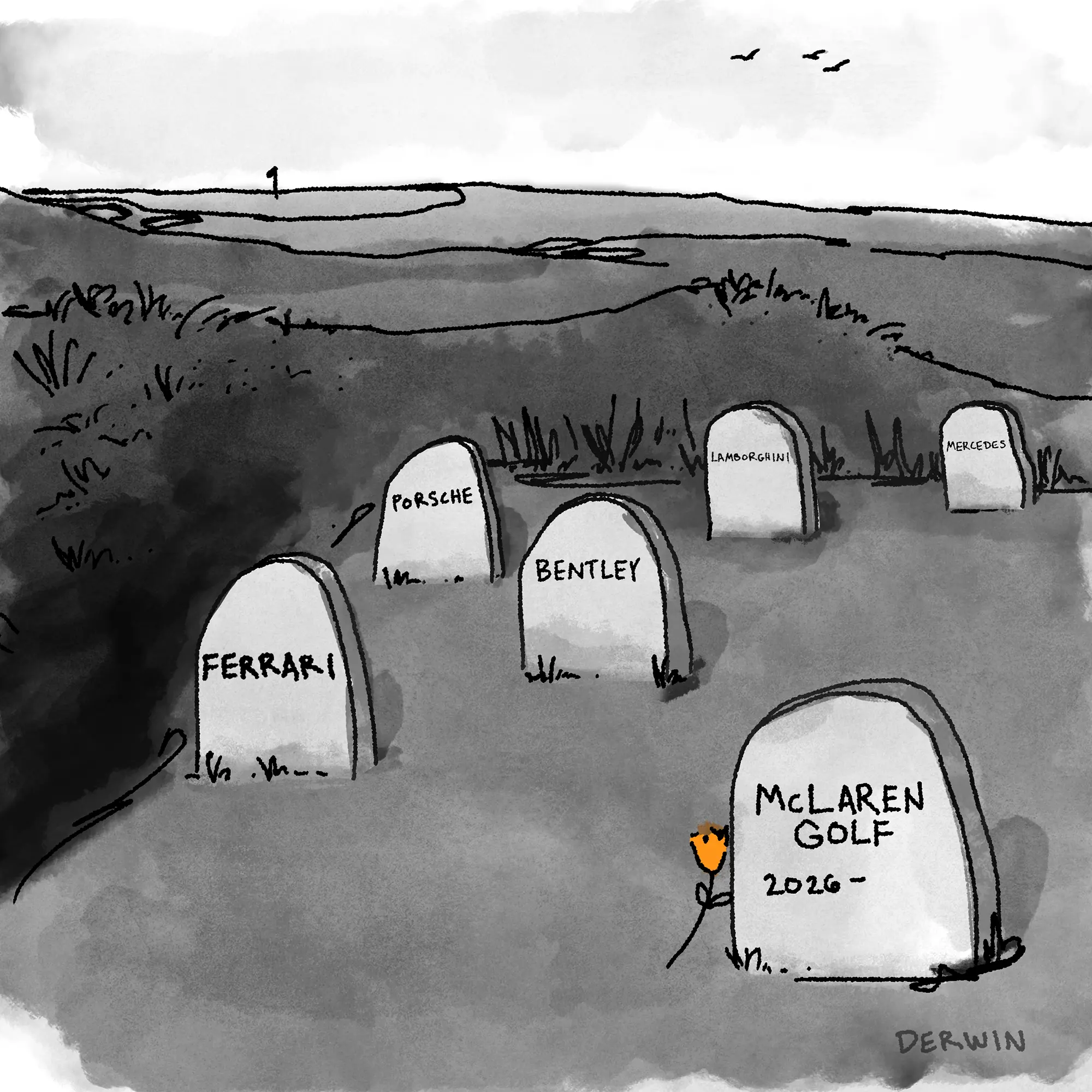
By establishing its golf division after many of its Formula 1 peers who have dabbled in club design and vanished like that internet-famous GIF of Homer Simpson retreating into the hedges, McLaren Golf isn’t entering an open space. It’s walking into a graveyard.
One thing working in McLaren’s favor, however, is that the brand itself was born out of failure.
Monaco, 1966
Bruce McLaren pulled onto the Circuit de Monaco in his white M2B on practice day wearing Hush Puppies with the toes cut off.
It was McLaren’s Formula 1 debut and the team was still finding its footing. McLaren left his racing boots in the hotel and ran Saturday’s practice session in his loafers, but the toes of the shoes kept getting in the way of using the pedals, so Bruce cut them off. He qualified 10th, securing a spot in the Grand Prix, but the weekend got worse from there. Just ten laps into the main race, the M2B suffered an oil pipe issue and was forced to retire. Bruce McLaren emerged from the car covered in oil, unable to continue the race.
While their first Grand Prix was anything but a success, it was how McLaren interpreted the race that would define the brand. Rather than view it as a failure, the team took what it learned during their week in Monaco as a commitment to press on. It resulted in a brand-defining motto: “McLaren never quits.” Since that first Grand Prix in 1966, McLaren’s Formula 1 team has won over 180 Grands Prix and 20 World Championships. When it hits its 1,000th Grand Prix this season, it will be only the second Formula 1 team to do so, joining Ferrari.
Doral, 2026
Sixty years later at the Cadillac Championship in Doral, the scenery was different, but the struggle felt strangely familiar. Justin Rose, the seventh ranked player in the world and McLaren Golf’s first major ambassador on the PGA TOUR, was +5 after two rounds, an abysmal performance for the first 36 holes played with McLaren’s Series 1 irons.
Had there been a cut, Rose would have missed it, and while the Englishman improved over the weekend, he finished T65 out of a field of 72. It was the golf equivalent of walking to the parking lot on Sunday with oil on his polo.
Just three weeks earlier, Rose had been in contention at Augusta National, battling Rory McIlroy deep into Sunday before finishing third at the Masters. Earlier in the season, Rose won at Torrey Pines with a record-setting performance that vaulted him back to No. 3 in the world, the oldest player to reach that ranking since Phil Mickelson.
At 45 years old, Rose is playing some of the best golf of his career. Which is why his surprise equipment change raised eyebrows. For a player in form, there’s usually no incentive to change anything at all, let alone their irons. And yet, just days before the Cadillac Championship, Rose announced a partnership with McLaren Golf and put the clubs directly into tournament play.
The obvious question became: why?
Why is McLaren Making Golf Clubs?
Ask Nick Collins, CEO of McLaren Automotive, and he’ll tell you that golf is “the ultimate crucible of individual determination, perseverance, resilience, intersecting with technology. A lot of those traits are there when you’re winning in a race car, or you’re developing a road car.”
In a launch video produced by Golf.com, Collins explains that “Golf resonates with those people who love motor sports, it resonates with those people who buy our cars. So there’s a really lovely intersect between the golfing world and McLaren world.”
Zach Brown, CEO of McLaren Racing adds that “there’s a tremendous amount of synergies around the technology of golf equipment and Formula 1 equipment. Materials, aerodynamics, compression, light weighting.”
So far McLaren Golf’s premise is solid, yet similar to other Formula 1 brands that have entered into golf club design. In other words, they believe their expertise in materials and aerodynamics translates to golf club manufacturing. Car people are often golf people too.
But, where McLaren begins to separate itself is in how seriously it appears to be taking the endeavor.
Unlike previous luxury car branded golf clubs, which relied on existing club manufacturers—Ferrari with Cobra or Porsche’s collaboration with TaylorMade—McLaren created its own golf division. McLaren Golf has its own leadership and team of design engineers who came from established manufacturers like Cobra, Callaway and Honma. According to McLaren, Justin Rose has been working with the engineering team for over a year, testing prototypes and helping shape the clubs before launch.
McLaren isn’t making a one-off release of clubs; it seems they have serious intent to stick around. “We’re building a brand grounded in McLaren’s high-performance DNA, and embedding it in a new sporting arena,” explains Neil Howie, CEO of McLaren Golf.
According to Howie, one of the first questions the engineering team reportedly asked internally was: “Does the shaft have to be round?”
It stands to reason that nothing is off the table in terms of design for McLaren Golf. The brand isn’t approaching the category like a licensing deal. They’re approaching it like engineers.
The Clubs
McLaren Golf launched with two sets of irons: Series 1 and Series 3.
Both are produced using Metal Injection Molding, a manufacturing process that differs from traditional forging and casting. MIM has existed in golf for several years and has been used by manufacturers like Cobra and Callaway as early as 2019, but McLaren is positioning the process as part of its engineering-first identity.
Take the Series 1 for example.
It’s a compact players iron with traditional 4-degree loft progression from the 9-iron through 4-iron and a honeycomb structure built into the cavity, a design language pulled directly from McLaren supercars. The structure allows weight to be redistributed around the perimeter of the head for stability and CG placement. All of the tech is hidden under the hood of an otherwise clean muscle-back cavity, save for the papaya McLaren logo stamped on the back.
McLaren Golf Series 1 Iron. Image Source: McLaren Golf
The Series 3 is more of a game improvement iron that helps players with less ball speed get the ball airborne with maximum forgiveness. It features a carbon-fiber “bonnet” which acts as housing for the internal weighting and to dampen vibrations.
McLaren Golf Series 3 Iron. Image Source: McLaren Golf
Both models are aggressively modern visually.
The Series 1, though, aimed at elite players, doesn’t attempt to hide its engineering. It’s not understated and elegant like a Miura blade or a Titleist 620 MB, although not entirely bad looking, either. The geometry is louder. More mechanical. More obviously “designed.”
Which makes sense.
McLaren road cars are not subtle either.
The starting price is $375 per iron before shaft upgrades. And, that pricing tells you almost everything you need to know about what McLaren Golf’s strategy is.
The Richard Mille of Golf
To understand the McLaren Golf pricing strategy, look no further than McLaren’s long-standing partner, ultra-high-end luxury watch brand, Richard Mille.
Richard Mille makes some of the most elaborate and visually impressive watches in the world. Their bold designs are engineering marvels which are lightweight, yet extraordinarily durable and are worn by top athletes like Rafael Nadal and Formula 1 drivers. Production of Richard Mille watches is strictly limited, with most models restricted to fewer than 100 pieces worldwide. Each timepiece demands years of development and months of painstaking, manual assembly. A microscopic flaw in a single component means scrapping weeks of work and starting over.
According to 2024/2025 Morgan Stanley and LuxConsult reports, Richard Mille has the highest revenue per unit in the Swiss watch industry (averaging roughly $250,000+ per watch), despite producing only about 5,300 pieces a year.
While McLaren isn’t alone in pricing their irons at $375 per club—Miura irons range from $310-450—the price is significantly higher than the “Big Four” manufacturers who control over 70% of the golf club and golf ball market. But McLaren Golf isn’t competing with Titleist, TaylorMade, Callaway or Ping because they aren’t following their same volume model; they are following the Richard Mille ‘revenue-per-unit’ model.
McLaren Golf doesn’t need a million people to buy their clubs, they just need to appeal to a small fraction of the market to be profitable. It’s a bet that a certain tax bracket of golfer doesn’t want a tool for a sport—they want a collectible piece of Formula 1 engineering that happens to be capable of hitting a golf ball.
That’s not to say their golf tech isn’t real, or the clubs are gimmicks. But if you look at the price to performance ratio, the McLaren Series 1 irons would have to be 175% better than the Titleist T100, the most played iron on the PGA TOUR. At $215 per club, the T100 comes with longstanding tour validation and multiple generations of iteration and refining. McLaren Golf can’t compete with that, so they have to do things differently.
McLaren Golf’s “engineering first” approach mimics the Richard Mille model of exposing the mechanics and making the process part of what the consumer is buying. Titleist, Miura and TaylorMade already create beautiful forged blades from decades of R&D and tour feedback. McLaren knows they need to bring the tech to differentiate themselves and justify the high price. It’s not just a set of clubs. It’s a system.
But they’re walking a fine line. Using Formula 1 inspired designs, newer weight distribution methods and splashing their signature papaya hue on the back may not be enough on its own to gain any meaningful traction in the golf industry.
Tour Validation
As a newcomer to the golf industry, what McLaren Golf needs for legitimacy is for its irons to be in the bag for a win in a professional golf tournament.
L.A.B. Golf was once considered an outsider with weird looking putters until J.J. Spaun won the 2025 US Open with a 65-foot putt using his DF3. The win immediately thrust the Oregon -based putter company into the mainstream. L.A.B. has since sent shockwaves across the entire putting industry with their lie angle balance technology, forcing other brands to play catchup and release their own version of a lie angle balanced putter to keep pace.
Tour validation is a huge catalyst for growth for club manufacturers and the bet is that Justin Rose will win a tournament with McLaren clubs. It’s not a bad bet, either. Rose is currently the seventh ranked player in the world with 13 career wins on the PGA TOUR and 12 wins internationally. Of those wins, he has used no less than three distinct sets of clubs: He won the 2013 U.S. Open with a full bag of TaylorMade clubs, the 2019 Farmers Insurance Open with Honma clubs and the 2026 Farmer Insurance Open with a mixed set of Miura, Titleist, TaylorMade and Callaway clubs.
With Rose an investor in McLaren Golf, he’s also betting on himself.
While potentially a positive, this is also a double-edged sword. As the only player on the PGA TOUR currently using McLaren Golf irons, Rose’s performance is now directly linked to the performance of McLaren golf clubs. Even if his double bogey on the first hole at the Doral was due to a bad drive, a club McLaren hasn’t yet released, the online chatter is, “Rose played poorly because of his new McLaren clubs.” This negative chatter will only get louder the longer Rose doesn’t post good numbers with McLaren Golf clubs in the bag.
Rose being an outward investor in McLaren Golf is also a potential negative in that his adoption of the equipment is not organic based on performance. J.J. Spaun was not sponsored by L.A.B. Golf when he won the U.S. Open. He chose to use a DF3 because he putted really well with it. The organic adoption of L.A.B. putters among elite players signals the technology is real, which is better advertising than any Super Bowl ad could buy.
This is where 8AM Golf comes in.
The 8AM Advantage
McLaren Golf isn’t going it alone when it comes to support for the venture. It’s part of 8AM Golf, an ecosystem of premium golf media, equipment, event and travel brands founded by Howard Milstein with Justin Timberlake as a partner.
8AM Golf properties include traditional Japanese club maker, Miura, golf publications Golf Magazine and Golf.com, Payntr Golf, which makes Justin Rose’s golf shoes, as well as McLaren Golf and True Spec Golf, one of the exclusive fitters for McLaren Golf clubs. It’s an army of high-caliber golf partners who all have a stake in each other’s success. Most importantly, 8AM Golf allows McLaren to bypass the traditional golf retail ecosystem entirely, avoiding a “floor war” with Titleist and TaylorMade in direct cost to performance comparisons by customers at the PGA TOUR Superstore or Golf Mart.
This is where McLaren Golf really separates itself from previous attempts at golf club design from luxury car brands and explains why they might succeed where the others failed. With 8AM Golf, McLaren can control the narrative in ways that support their luxury image. With built in fitting channels like True Spec Golf, McLaren Golf can sell their clubs as an experience, a system finely tuned to each iron rather than a set of golf clubs.
By selling through premium fitters, McLaren Golf is able to control presentation and maintain the level of personalization that luxury consumers want. And, due to the 8AM Golf connection to established golf media outlets, they’re also able to control messaging.
With Golf.com and Golf Magazine inside the same ecosystem, McLaren Golf enters the market with immediate access to visibility, editorial coverage and an audience already conditioned toward premium golf products. The 8AM Golf partnership is able to provide McLaren Golf much more of a “luxury watch” model than traditional golf retail.
The structure dramatically increases McLaren Golf’s runway in an industry where most equipment startups never survive long enough to iterate. But eventually, every golf club company runs into the same problem: performance.
Where the Rubber Meets the Road
People don’t buy a Richard Mille watch because they need to know the time. It’s a luxury, a status symbol, an investment in the process and brand philosophy more than its function of telling time.
This is not the case with a luxury golf club, which has a function beyond representing an idea or appearing as a status flex. A golf club, no matter how luxury or engineered it is, has to contend with the scorecard at the end of the day.
Richard Mille makes Rafael Nadal’s watch. They’re not trying to make his racket.
While McLaren Golf isn’t competing with Titleist on price, they are competing with them on performance, whether they want to or not.
Speed Bumps Ahead
Despite the fact that McLaren Golf is doing things differently to gain a foothold in the industry long term, they face an uphill battle.
Where Richard Mille can design their watches to almost infinite configurations, McLaren Golf can only push so far. Their biggest competitor isn’t other golf club manufacturers, but the USGA and R&A, which place hard limits on equipment performance. McLaren can only push club designs so far before regulations flatten the innovation curve back toward everyone else. There’s also the unavoidable reality that if the clubs don’t perform as well as the price implies, golfers will not care how interesting the engineering story is. If the performance isn’t better than what is out there for half the price from legacy golf brands, why buy McLaren Golf clubs other than for status?
Continued poor performance from Rose will also start to weigh on the McLaren Golf brand and send it into the wall quicker than Leclerc at the Miami Grand Prix. If things start to go in that direction, Rose can always work with McLaren Golf’s R&D team to tweak the designs to work better for him.
Rosey is one of my favorite players and I am excited about McLaren Golf. I think having a manufacturer whose premise is to question and experiment is only good for the game, that is if they make an honest attempt to iterate and come up with designs that improve players scores.
The unfortunate truth though is elite players are sticky with their gear and the best players in the world often use less tech, not more. They want some forgiveness at the top end of the bag but control in their scoring clubs, which is why many of the top ten players on the PGA TOUR, including world number one Scottie Scheffler, Rory McIlroy, Cameron Young, Collin Morikawa and Tommy Fleetwood play muscle-back blade irons at least through the mid irons—clubs which have little to no technology in them but provide the most feedback and allow the most control and shot shaping capabilities. Rose himself, during stretches as a gear-free agent, played Miura MC-502 irons in part of his set.
There is a risk that McLaren Golf over engineers their clubs for the sake of being different and they may have to consider that a successful golf club might not be inspired by a Formula 1 car part. It might just be a well-designed single piece of metal on a stick.
If McLaren Golf comes up with sticks and not schticks, they have a real shot.
Either way, McLaren Golf entered the world on April 29, 2026. What date follows it on the headstone — whether short-lived like the luxury car-branded golf clubs that came before it, or decades long and still counting, like McLaren Racing itself—is up to them.
Bethpage Black is one of the most iconic courses in the world. At 7,468 yards from the back tees, it’s an absolute beast. The Black Course’s difficulty isn’t just spread by word of mouth by those who have played it—it’s physically printed on the iconic sign that hangs just behind the first tee: “-WARNING- The Black Course Is An Extremely Difficult Course Which We Recommend Only For Highly Skilled Golfers.”
With notoriously thick and punishing rough, the A.W. Tillinghast masterpiece is beloved for its nearly tournament-ready condition all season-long and the tough but fair test of golf it provides. Tough, because if you get out of position you can find yourself in a world of trouble. Fair, because the Black Course isn’t gimmicky in its design. Everything is right in front of you and good shots are rewarded while poor shoots are punished—often severely. The greens are relatively benign in terms of slope; the main issue is getting to them. Keeping the ball in the fairway off the tee is a must, and even then, it’s no walk in the park.
There are no “position” holes at Bethpage Black. If it’s not a par-3, it’s driver off the tee. Not only do you need to hit drivers all day, but you need to hit them long and accurately to avoid the penalizing rough and bunkers that line the fairways.
It’s a tall order made all the more difficult by one inconvenient fact: you cannot hit drivers on the practice range at Bethpage.
It’s been that way forever, as locals know all too well and visitors are surprised to find out. At just over 200 yards in length from the shortest angle, the current practice range boundary net is an easy carry for drivers. It’s not just a matter of wasting range balls into the trees, it’s a safety issue. Round Swamp Road is not far beyond the fence line, meaning drivers could easily send projectiles into unsuspecting traffic.
Not that this stops visitors and some locals who know better from trying to rehearse hitting a couple of big dogs before their tee time. The unmistakable “ping” of a driver can be heard every now and then on the range but the city employees at Bethpage have ears like hawks and are pretty quick to put the kibosh on such behavior.
The closest I can get to warming up with driver before playing Bethpage is hitting 3-wood off the mat, and even those I can carry over the fence depending on the line I take. It’s an unavoidable certainty that unless you are playing in the Ryder Cup, U.S. Open, or PGA Championship at Bethpage Black, the first driver you hit all day will be on the first tee of the most punishing courses in the country.
But that is about to change.
Why the First Tee May Soon Feel A Little More Comfortable
Renovations are under way to the Bethpage practice range which, among other improvements, will allow players to finally be able to hit drivers. It’s a welcome addition to the world-class facility which features five 18-hole regulation courses, including the famed Black and Red courses, making it one of the largest municipal golf complexes in the world.
A first look at the taller perimeter fence posts as viewed from the practice range at Bethpage State Park. Photo by David Derwin.
I played my first 2026 round on Bethpage Red yesterday and got a glimpse of the progress of the driving range renovations. The first thing that stood out to me was just how tall the new boundary net will be. The white poles are massive, at a height now capable of catching drives that were previously bound for Round Swamp Road.
The new perimeter net posts are now visible to the left of the clubhouse, as viewed from the first green on the Red course. Photo by David Derwin.
While I look forward to rehearsing my driver swing prior to the first tee, an unfortunate result of the taller poles is they are now visible from the course where the shorter fence was not. It’s a permanent alteration to the property’s skyline, one that is particularly noticeable when standing on the Black Course’s 18th tee.
Viewed from the 18th tee on the Black Course, the new range netting is significantly taller than before, a visible tradeoff for a more functional practice facility. Photo by David Derwin.
It’s a trade off for progress. In addition to a taller perimeter net, the range is pivoting toward the future with the installation of Inrange® technology, bringing radar tracking and data-driven insights to the facility. The renovation will also bring a new continuous hitting surface which will provide a uniform look and better feel off the mat.
The updated driving range at Bethpage is set to open around mid-May, according to pro-shop staff. Once open, players can finally rehearse their driver swings, making the first tee on one of the most intimidating courses in golf just a little more comfortable.
Products featured in this story may include affiliate links. The Golf Player may earn a small commission if you make a purchase, at no additional cost to you.
Every year I register for the Masters ticket lottery. It’s a tradition unlike any other where I submit the application and for a fleeting moment picture myself walking the hallowed grounds of Augusta National, sitting in my green fold-out chair on Amen Corner, sipping an Azalea, the tournament’s signature cocktail, and of course imagining how much money I’ll blow on merch.
Official Masters merch can only be purchased at the tournament, which dashes my hopes of adding the 2026 Masters garden gnome to my backyard, but brands get in on the excitement of the first major of the year by releasing limited-edition Masters-inspired gear of their own, just in time for the honorary tee shots to fly.
The problem is, most of it sucks. Many brands phone it in, throw an azalea or pimento sandwich on a polo and call it a day. It’s loud. It’s ugly. It lacks nuance.
But this year, after receiving my annual regrets that my application was not selected for tickets, I’ve found the smartest take on Augusta-inspired merch that might even be better than what they sell at that silly tournament nobody wants to go to anyway (if you have an extra ticket, email me at editor@thegolfplayer.com. I have Venmo.)
RADMOR’s Bauhaus x Augusta Collection
RADMOR’s Augusta x Bauhaus Capsule Collection is a masterclass in design done right. The Seattle-based sustainable golf and lifestyle brand’s latest drop—featuring tees, hats, a hoodie, and a crewneck—replaces the typical floral kitsch with the minimalist aesthetic of the Bauhaus school.
At first glance, Augusta National and the German design movement founded in 1919 don’t seem to have much in common. One doesn’t walk onto the hallowed grounds and immediately think of Walter Gropius’ architectural revolution. However, connecting the Alister MacKenzie masterpiece with the Bauhaus mission makes a surprising amount of sense.
Gropius founded the school to “bring together all creative effort into one whole, to reunify all the disciplines of practical art—sculpture, painting, handicrafts, and architecture.” The movement became the primary champion of the “form follows function” philosophy, which in architecture, means the function of the building informs how it should be designed. Architectural flourishes for non-functional reasons should be avoided.
When looking at Augusta National through this lens and viewing it not as a golf course but as a piece of architecture, its elements can be separated into their functional components. Tee boxes are where the players start the hole. The ball lands in either the fairway or rough, maybe a bunker. There are water hazards and putting surfaces. To visually represent Augusta National then, doesn’t require a detailed replica of any specific hole or feature of the course, but simply smart design that utilizes shape and color to suggest the setting rather than replicate it.
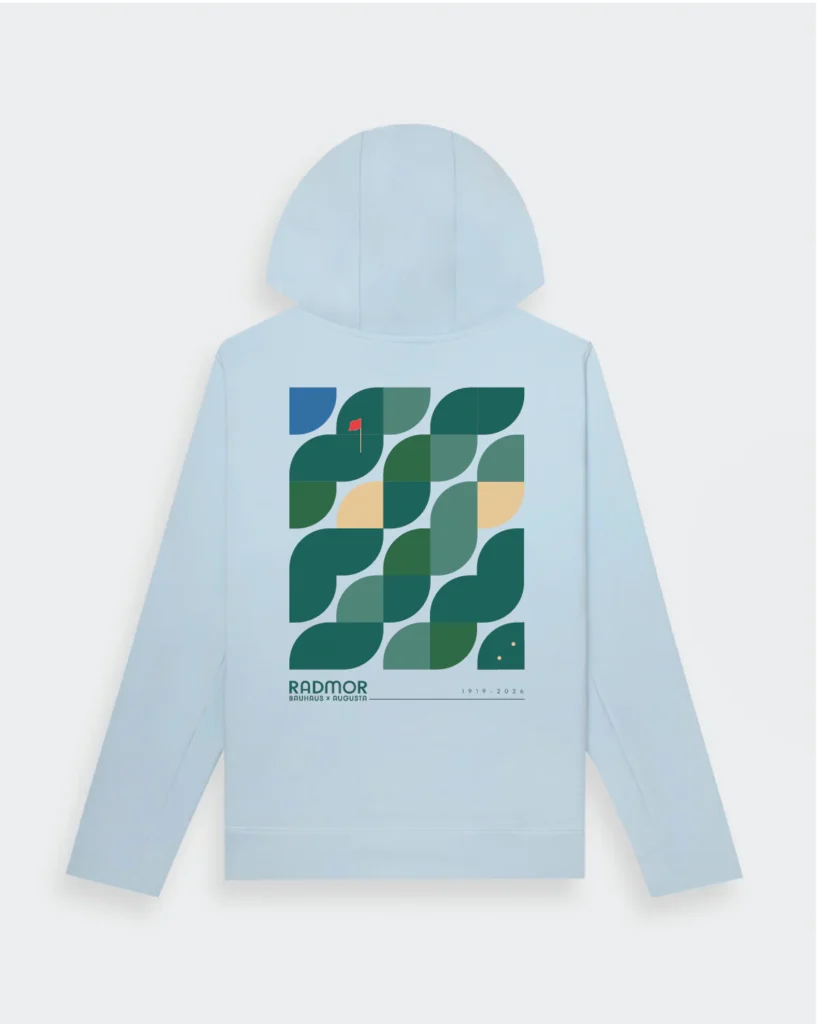
Bauhaus x Augusta ‘Modular Composition’ Hoodie. Image Source: RADMOR
It features a grid-like modular design which represents a golf hole through simple and repeated geometric shapes. By making all of the shapes the same and thereby removing shape as a tool to describe form, defining different areas of the golf course comes down to color. A blue shape becomes a lake. Beige becomes a bunker. A palette of muted greens becomes the fairway and rough. A simple pin denotes the green. It’s instantly recognizable as a golf course, though abstracted through a Bauhaus lens.
The Bauhaus x Augusta ‘Modular Composition’ Hoodie doesn’t appear to represent any one specific hole at Augusta—it’s more of a minimalist Rorschach test which invites the viewer to imagine whichever hole at Augusta they’d like. The suggestion of a fairway bunker on the right, I see Hole #2 Pink Dogwood but the lake behind and to the left of the green is giving Hole #11 White Dogwood.
It’s a fun design that interprets the source material without replicating it.
Rather than go on the nose with Masters Green Pantone 342, the design utilizes a restricted color palette of muted greens, blue and beige. Printed on an sky blue Higgins 2.0 hoodie, made from a lightweight blend of Organic Pima Cotton and elastane for breathability and comfort, the design calls upon the traditional color palette of the Masters without being so literal.
This is the genius of RADMOR’s design. It evokes Augusta without literally throwing pimento sandwiches on it. It’s not phoned in—it’s thought out. It’s understated and smart. Plus, it looks awesome.
The Bauhaus designs and restricted color palette are present throughout the collection. The classic fitting Augusta Logo Dad Cap features RADMOR’s take on the Masters tournament emblem and is perhaps the most direct nod to the tournament. The pin and flag remain from the classic tournament logo but modernized and perched above RADMOR text in an all lower-case Bauhaus-style rounded font.
Bauhaus x Augusta Logo DadCap. Image Source: RADMOR
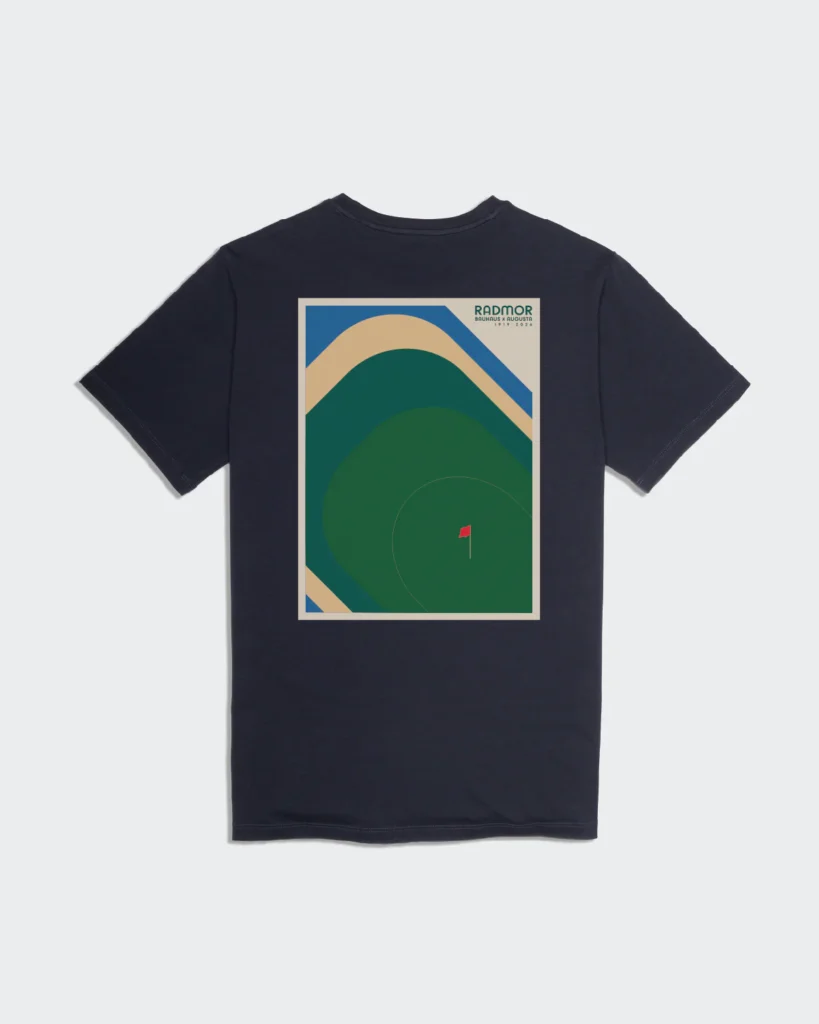
The “Rays” Stretch Tee (a nod to Augusta’s famed Rae’s Creek) features a minimalist depiction of a golf hole where radiating shapes expand outward from a central green, invoking Hole #12 Golden Bell without throwing it in your face.
Bauhaus x Augusta ‘Rays’ Stretch Tee. Image Source: RADMOR
Form Follows Function
Beyond the aesthetics, RADMOR’s fit and materials are second to none. Their industry-leading sustainability practices—from their meticulous choice of natural, biodegradable fabrics all the way through their transparent manufacturing processes—ensure these pieces will last long after the final putt drops on Sunday. In a world of polyester-heavy “fast fashion” golf shirts, RADMOR offers a more permanent, planet-friendly alternative.
Ultimately, RADMOR’s lean away from loud, literal branding toward considered design with genuine lifestyle crossover is a home run. This collection successfully taps into the vibe of Augusta, grounding itself in the most traditional week in golf without being held captive by it. It’s sophisticated, it’s sustainable, and most importantly, it’s wearable far beyond the month of April.
If you too, found yourself on the wrong side of the Masters ticket draw and will be watching the action from the comfort of your own home, check out the full collection to rock some seriously awesome Augusta gear in time for Jim Nantz to say, “Hello friends, welcome to this tradition unlike any other.”
In the world of public-access golf in the United States, few courses rise to mythic proportions: Bethpage Black, Torrey Pines, and Pebble Beach, just to name a few. I would put TPC Sawgrass in that category as well. The Pete Dye masterpiece is put on display on the world stage once a year during THE PLAYERS Championship, but remains open year-round to players of all skill levels. One thing golfers who step onto the tee at TPC Sawgrass will immediately notice is the water.
There is so much of it.
Lakes appear everywhere—guarding greens, framing fairways, and most famously surrounding the par-3 17th hole. At first glance, it might seem like these hazards were placed simply to create a diabolical test of golf. However, the real reason there are so many lakes at TPC Sawgrass has just as much to do with the spectator’s experience as it does the players.
A Stadium Built From the Ground Up
In the late 1970s, PGA TOUR Commissioner Deane Beman had a radical dream: a permanent home for the TOUR’s flagship tournament that was designed specifically for fans. He purchased 415 acres of wooded wetlands and swamp in Ponte Vedra Beach for the sum of just one dollar. At the time, the land was so inhospitable and snake-infested that the groundbreaking ceremony had to be held on the edge of the highway because the interior was inaccessible.
Beman worked with legendary architect Pete Dye to create a “stadium” for golf. They wanted natural viewing areas—elevated mounds that mimicked the angled seating of a football or baseball stadium—so that thousands of fans could watch the action without standing ten-deep on flat ground.
There was just one problem: the property was almost entirely flat, with no more than 18 inches of elevation change across the site. To build the 30-foot spectator mounds they envisioned, Dye needed massive amounts of dirt.
Because the project was operating on a tight budget, they couldn’t afford to haul in fill from off-site. The solution was simple but transformative: excavate the soil from different parts of the property and use it to build the mounds. The resulting pits were filled with water, creating the intricate network of lakes that define the course today.
Illustration by David Derwin
The Accidental Island Green
The most famous example of this “dig-and-build” strategy is the 17th hole.
Early designs called for a conventional par-3 with only a small pond near the green. However, as construction progressed, workers discovered that the area around the 17th green contained the best sand on the property—a valuable material needed elsewhere to cap fairways and build the base for the greens.
Dye’s team kept digging and hauling sand away until a massive crater remained. With the tournament approaching and the land around the 17th green virtually gone, Pete Dye was reportedly stumped. It was his wife and design partner, Alice Dye, who offered the legendary suggestion: “How about an island green?”
What began as a construction necessity became one of the most recognizable holes in golf.
Water With a Purpose
The lakes of TPC Sawgrass serve a purpose far beyond providing drama to the 17th hole. On the finishing 18th hole, the massive lake that guards the entire left side of the fairway provided the dirt for where fans now sit to watch the tournament conclude.
In art and architecture, negative space is the area around the subject that defines it. At TPC Sawgrass, the spectator mounds that define the stadium viewing experience become the subject and the lakes, the negative space.
Today, these water hazards serve multiple purposes:
They act as strategic hazards that test a player’s nerves.
They function as a sophisticated drainage system for the Florida marshland.
They provide the “negative space” left behind by the creation of the stadium mounds.
If you took away the lakes, the mounds would disappear, and it would just be another flat Florida golf course. At TPC Sawgrass, the depths of the hazards are exactly what allowed the heights of the stadium to exist.
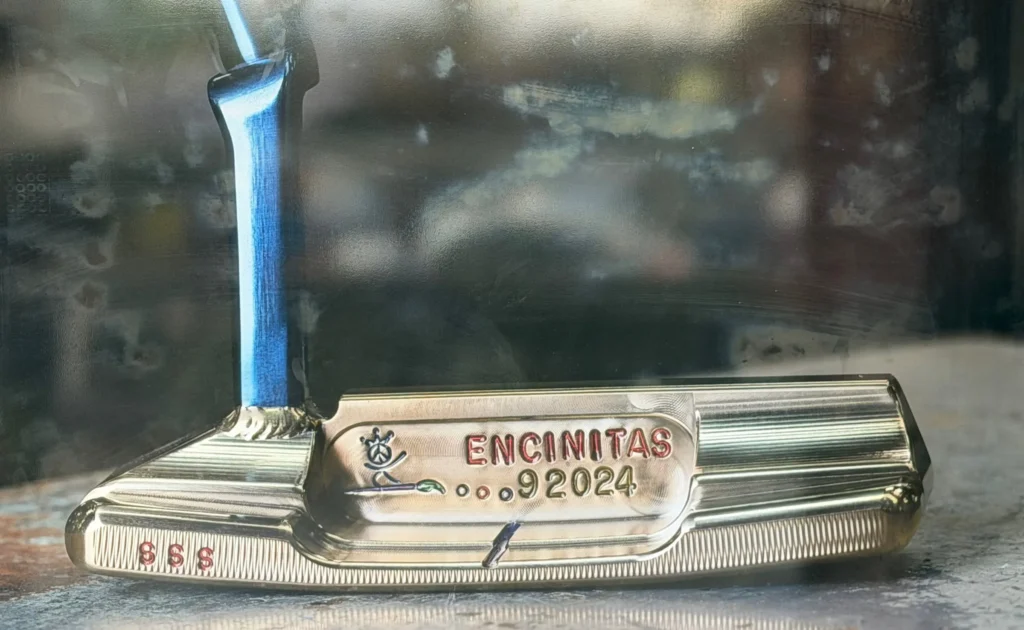
There is a window display along historic Highway 101 with a picture of a putter golfers dream about—a rare Scotty Cameron prototype with a unique stamping on the back: a stick figure with a peace sign for a head, wearing a three-pointed crown, surfing on a paintbrush.
The design imbues coastal lifestyle, craftsmanship and art—The Art of Putting.
It is also the perfect embodiment of Encinitas, the laid-back and charming beach town in Southern California where Scotty Cameron established the Scotty Cameron Gallery in 2014. The coastal community is more than just a location; it is woven into Cameron’s work. On rare putters like the Timeless TT (Tour Type) SSS Chromatic Bronze & Blue prototype featuring the peace surfer design, the word “ENCINITAS” and its zip code, “92024,” are hand-stamped directly into the back.
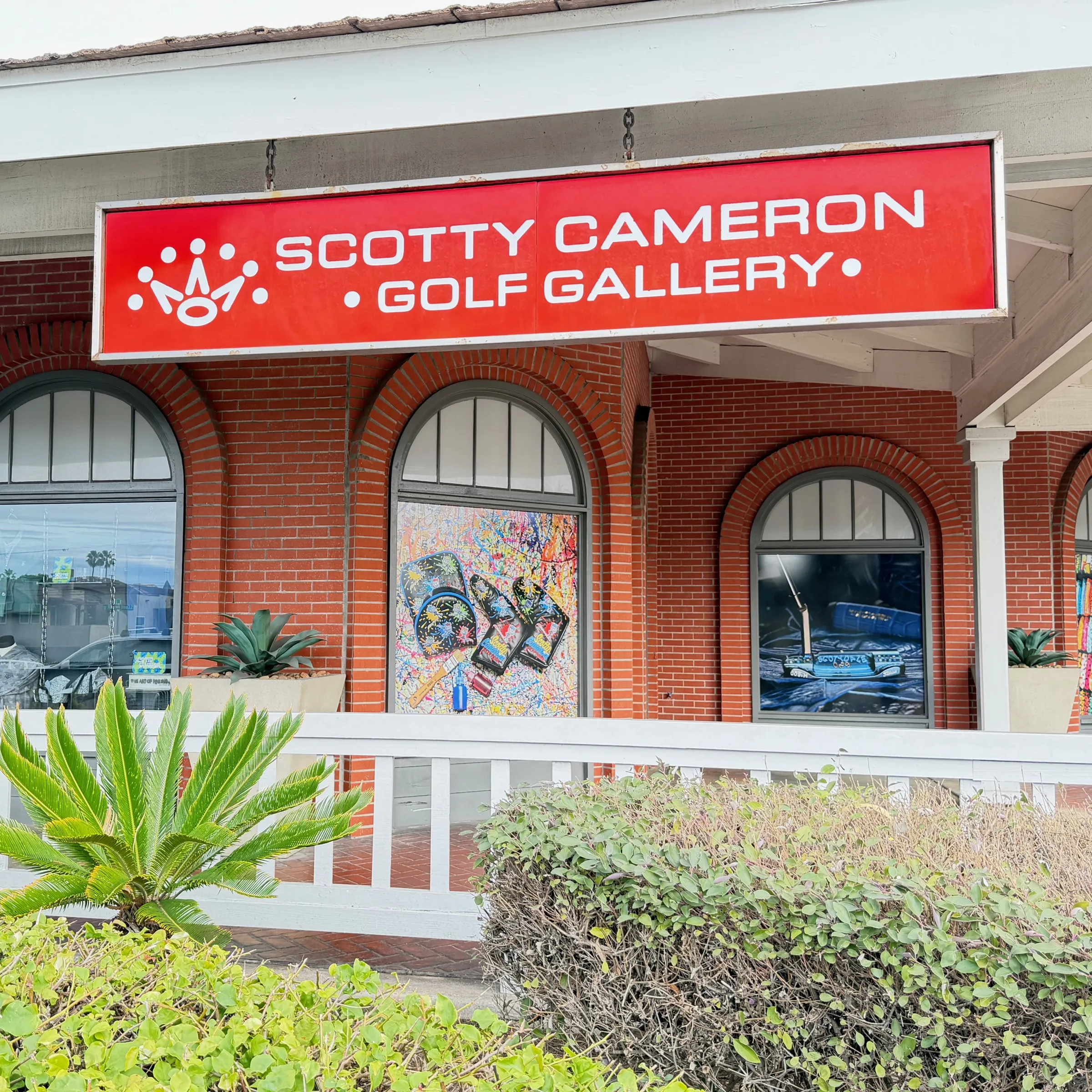
One look at the window display and it is clear this is not your ordinary golf shop.
A window display at the Scotty Cameron Gallery in Encinitas features a photograph of a rare custom putter. Photo by David Derwin.
“I’ve always wanted a retail store where people who want Cameron items can come in and see great creations, and really price is no object when it comes to the design end,” Cameron said in a video, describing the gallery.
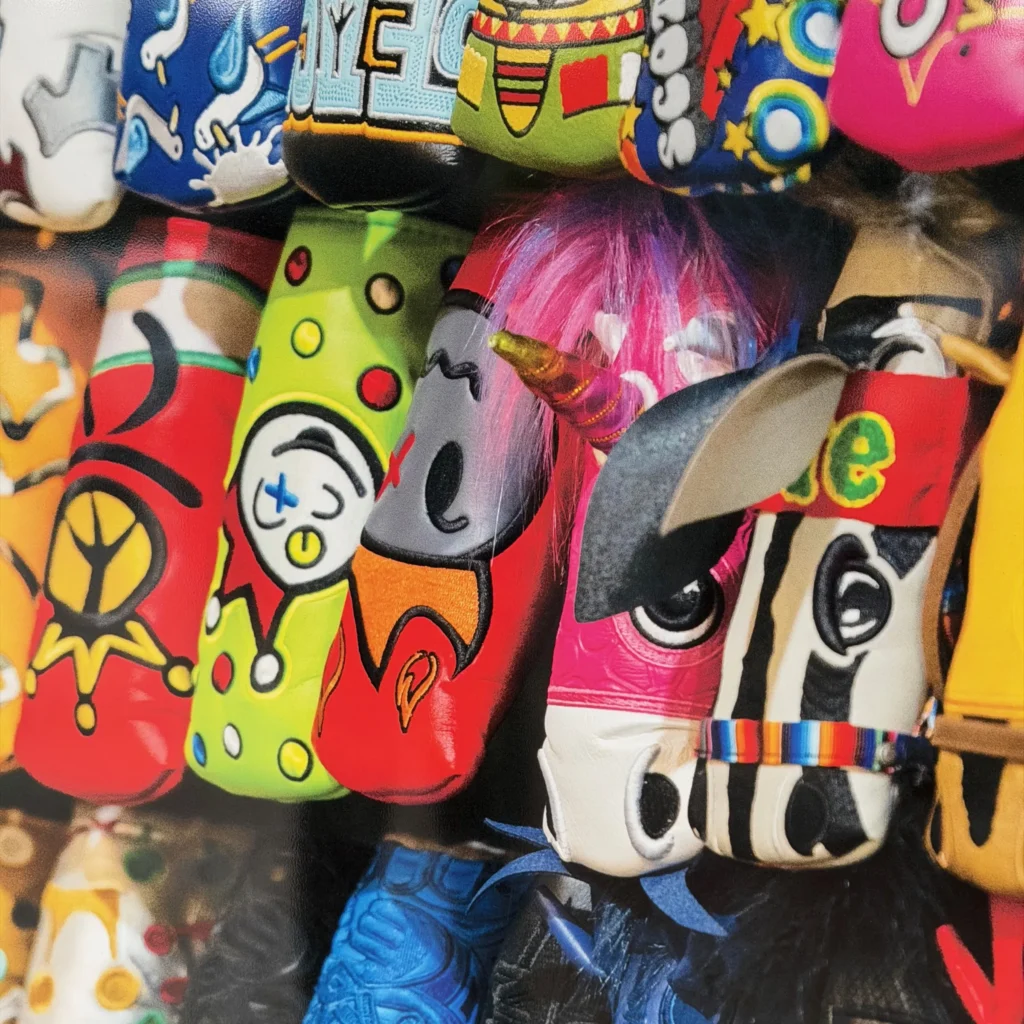
The Scotty Cameron Gallery, located in downtown Encinitas, is a retail boutique and putter fitting studio where Cameron’s creations are on full display. And not just putters. The gallery features one-of-a-kind creations by Cameron, from ball markers and divot repair tools to headcovers, bag tags, golf towels, glassware, beach towels, hats, apparel and more, all featuring Cameron’s signature designs, like the Scotty Dog, crown, joker, rat and surfer.
Emblazoned on many of the items is the Circle Ticon, the unmistakable logo reserved for Tour Only putters. It is a coveted marking, one that signals rarity and makes even the smallest accessory feel like a piece of Cameron’s inner workshop.
Cameron’s designs, embroidered on Peter Millar apparel ranging from polos and jackets to hoodies and vests, blend timeless fashion with a funky, whimsical edge that feels equally at home on the golf course or at the taco shop down the street. His designs draw inspiration from his Southern California upbringing in Huntington Beach and his home in nearby Carlsbad. Rats carrying surfboards, lifeguard towers and surfers appear in Cameron’s minimalistic art style, often rendered in unexpected color combinations that feel unmistakably coastal.
The roots of that design language trace back to Cameron’s earliest days building putters in his garage.
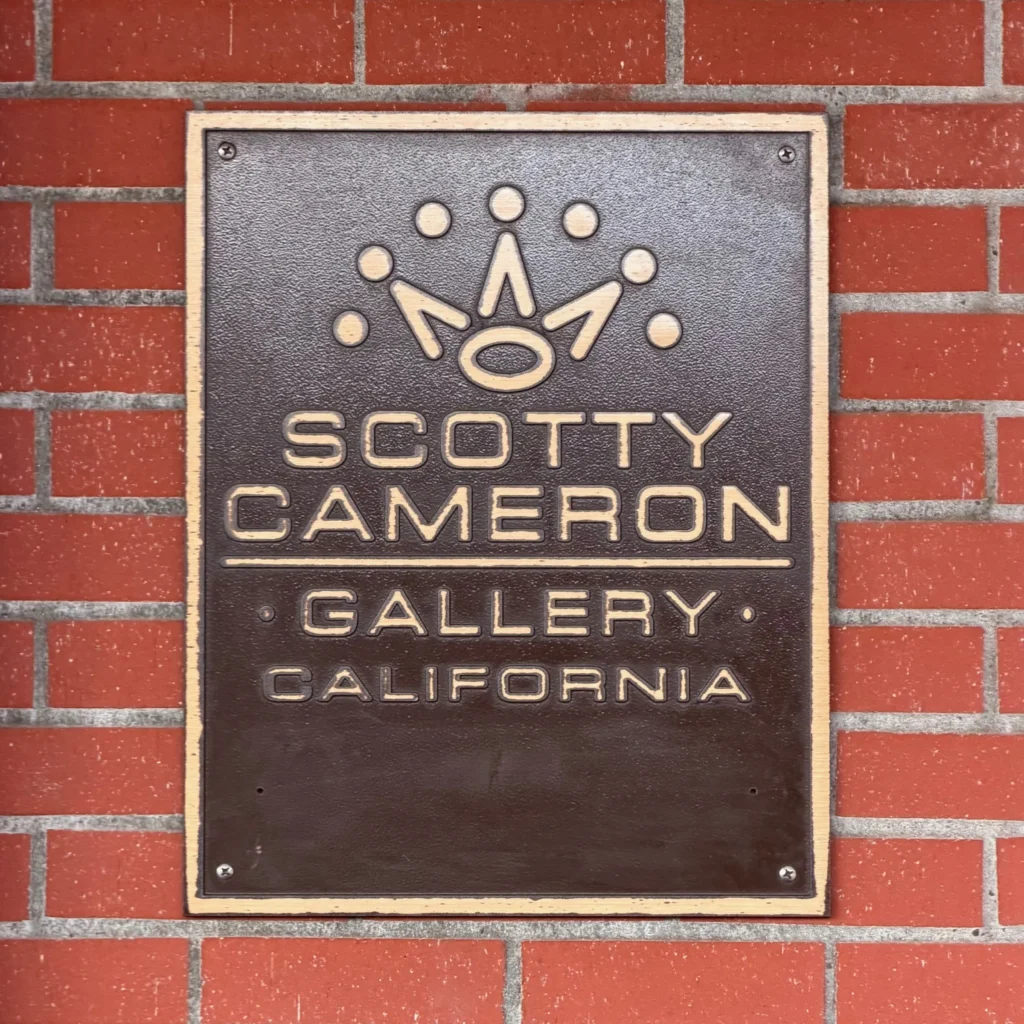
Without the means to commission a formal logo, Cameron turned to the tools he had on hand. His iconic crown logo was created using a sideways zero stamp with three upside-down “V’s” forming the crown’s points, finished with seven dots representing the seven days it took him to build a putter from start to finish. The design was born out of necessity, but its simplicity became his signature style. Clean lines. Bold shapes. Instantly recognizable.
The iconic Scotty Cameron crown logo displayed on a plaque outside the Scotty Cameron Gallery in Encinitas. Photo by David Derwin.
Those same principles carry through everything in the gallery today. The items feel intentional. Personal. Hand-made in spirit, even when produced at scale.
Items sold at the Scotty Cameron Gallery are made in extremely limited quantities. What is in stock today may not be there next week and items are likely to never be available again once they sell out. The inventory rotates constantly, creating a sense of discovery and encouraging repeat visits. No two trips feel exactly the same.
That rarity is not accidental. It is central to what makes the gallery special.
“I like to see innovation and I wanted to be able to dream,” Cameron said of his vision for the gallery. “Whether it’s an alligator grip or a sterling silver insert, we will have stuff there that you won’t see any place else in the world.”
That last part isn’t hyperbole—the Encinitas Gallery is the only Scotty Cameron retail location in the world. While there is a second Gallery in Shizuoka, Japan, it operates primarily as a museum and does not offer retail. Some apparel and accessories occasionally appear on the Scotty Cameron online store, but the vast majority of items are available only in person at the Encinitas Gallery.
If you are a golfer, the name Scotty Cameron precedes the visit. You know the putters. You have seen them win majors. But what you may not know is the depth of Cameron’s creative output outside making some of the best putters in the world.
Capacity inside the gallery is limited, and a wait is part of the experience. When you arrive, you add your name to a waitlist at the door. You leave your phone number and group size, and they text you when it is your turn to enter.
And so you find yourself back at the window display.
While you wait, the windows offer a preview of what is inside. They are thoughtfully curated and have long been part of the gallery’s identity. During COVID, the gallery operated entirely through window shopping, with customers filling out scorecard-like sheets using golf pencils to select items displayed behind the glass. The gallery has since returned to full in-store browsing, but the windows remain the gallery’s introduction, setting the tone before you ever step inside.
Photography is prohibited in the store, preserving the sense that what you are seeing exists only in that moment. It makes the visit feel more personal, more immersive, and more memorable.
Beyond the retail space, there is a full putting studio where golfers can be fitted for putters. Players can also bring their Scotty Cameron putters to be re-gripped on site. More extensive custom work, including stamping and restoration, is handled at Cameron’s nearby San Marcos facility.
Even for those who have never played golf, the gallery holds its own appeal. It is as much a design gallery as it is a retail space. Art lovers will instantly recognize and appreciate the craftsmanship and clarity of vision carried through every object, from Tour Only putters and apparel, down to the smallest accessories.
A photograph of rare and unique Scotty Cameron putter headcovers displayed in the window of the Scotty Cameron Gallery in Encinitas. Photo by David Derwin.
Plan Your Visit
Scotty Cameron Gallery
927 S Coast Hwy 101 #100, Encinitas, CA 92024
After your visit to the Scotty Cameron Gallery, enjoy an afternoon along historic Highway 101 with a curated list of the best the area has to offer:
Pannikin Coffee
510 N Coast Hwy 101, Encinitas, CA 92024
Housed in a historic train station originally built in 1888, Pannikin Coffee is hard to miss with its bright yellow exterior. Serving coffee, tea and house-baked pastries since 1968, it remains a local favorite for its friendly vibe, relaxed atmosphere and rotating display of local art.
Juanita’s Taco Shop
290 N Coast Hwy 101, Encinitas, CA 92024
Family-operated since 1980, Juanita’s is beloved by locals for some of the best Mexican food in North County. Go-to orders include the California burrito and the fish tacos.
Modern Times Brewery
470 S Coast Hwy 101, Encinitas, CA 92024
Opened in 2018, Modern Times offers craft beer in a bright, thoughtfully designed space with large open windows along Highway 101. The brewery features 30 beers on tap, ranging from favorites like the Orderville Hazy IPA to specialties like the Pickle Pils—a M.T. Pils served with a salt rim and pickle brine.
Hansen Surfboards
1105 S Coast Hwy 101, Encinitas, CA 92024
Family-owned since 1961, Hansen’s reflects Encinitas’ deep surf heritage. The shop carries beach and snow apparel, surfboards and snowboards—everything needed for a day at the beach or on the slopes.
La Paloma Theatre
471 S Coast Hwy 101, Encinitas, CA 92024
Anchoring downtown Encinitas since 1928, La Paloma is a historic single-screen theatre and one of the first to show “Talkies.” Inside, it still features the pipe organ that was used during the Silent film era. Its classic vertical marquee remains a Highway 101 treasure.
Walk Along the Seaside Bluffs
Cross Highway 101 from the Scotty Cameron Gallery and head south along the bluffs overlooking Swamis and Pipes Beach toward Cardiff. Along the way you’ll catch gorgeous ocean views, a walk especially majestic at sunset. A good turnaround point is the surfer statue known as “The Magic Carpet Ride,” though locals call it the “Cardiff Kook” for its awkward surfing stance. The locals celebrate The Kook by frequently dressing it up for holidays and events.
The seaside bluffs overlooking the Pacific Ocean along Highway 101 in Encinitas. Photo by David Derwin.
Your Next Read
The Golf Player’s in-depth review of L.A.B. Golf’s OZ.1i HS.