Charles Leclerc should have known better. On worn tires but fighting to keep pace, the Scuderia Ferrari driver engaged in a dogfight with McLaren’s Oscar Piastri for a podium finish at the 2026 Miami Grand Prix. Leclerc let Piastri pass him on the penultimate lap to gain a DRS advantage for a final-lap counterstrike, but the gamble didn’t pay off. The decision to push, even with a damaged car, showed the fighting spirit of the 28-year-old Monegasque. But the gamble backfired, sending the Ferrari into the Turn 3 wall which allowed Piastri to finish P3 uncontested.
It was a dramatic finish to a banner weekend for the McLaren Formula 1 team. A P1 and P2 sweep in Saturday’s Sprint, followed by a double podium in Sunday’s main race, earned McLaren a massive 48-point haul, the largest of any team that weekend. It was proof that their latest upgrades were a resounding success for ‘Team Papaya’, which was also celebrating its upcoming 1,000th Grand Prix later this season.
Just 10 miles away from the Miami International Autodrome, McLaren was celebrating a milestone first in Doral—the debut of McLaren Golf clubs on the PGA TOUR.
McLaren Golf
A luxury car brand entering the golf space is a story we’ve seen before. Ferrari, Bentley, Porsche, Lamborghini and Mercedes have all brought golf clubs to market over the past two decades, each promising advanced performance on the course due to their automotive expertise in materials and aerodynamics. From the $2,000 red Cobra Ferrari Driver with custom leather grip to the Bentley BC2 Japanese forged cavity back irons that retailed for $550 per club, these luxury sticks may have succeeded in garnering attention, however they failed to create a living lineage in golf.
The luxury car branded golf clubs were mainly one-off releases. None of them produced a second, third, or fourth generation that evolved based on player feedback. Once the initial novelty wore off, they mostly remained as collectibles. Some can be found trying to re-home themselves on eBay.
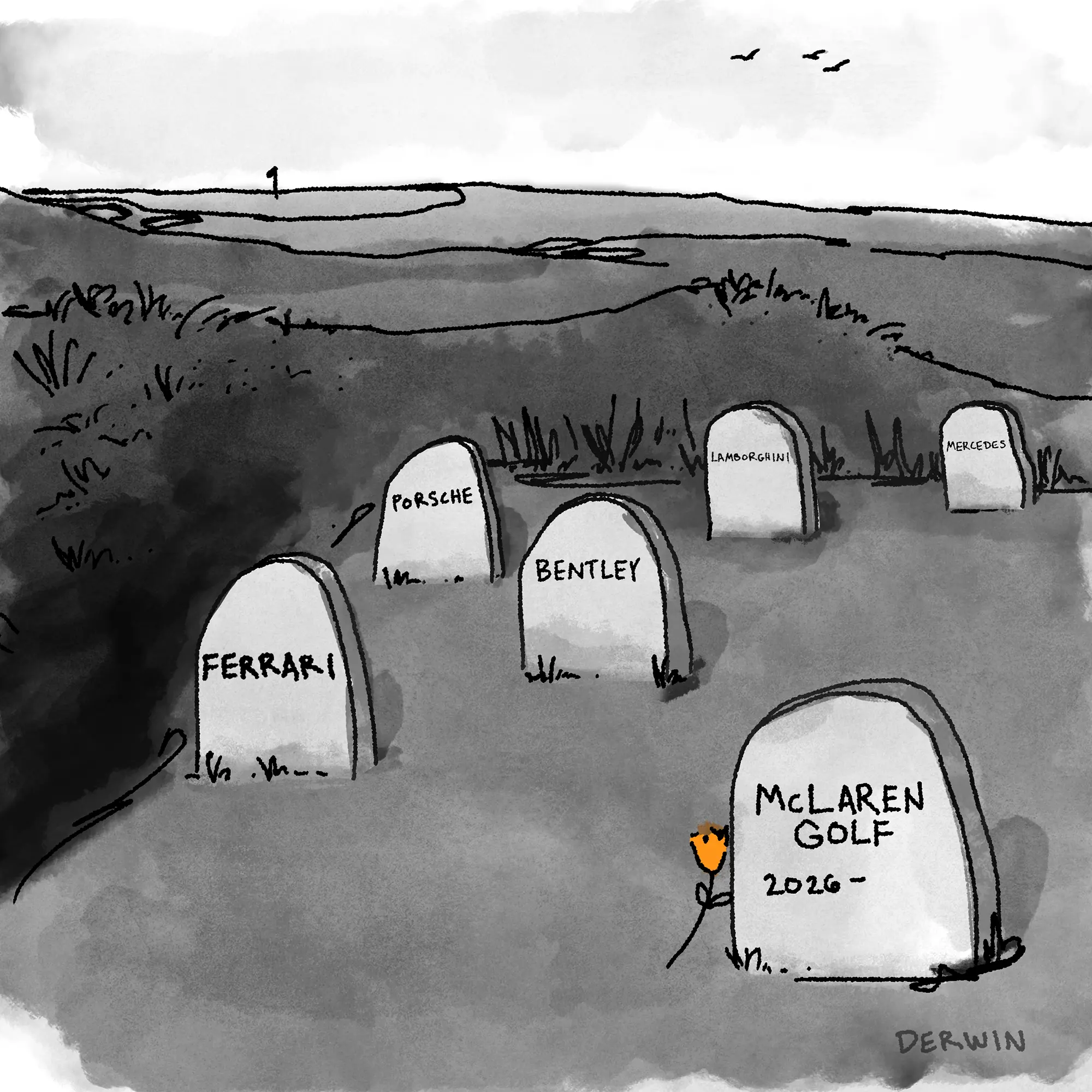
By establishing its golf division after many of its Formula 1 peers who have dabbled in club design and vanished like that internet-famous GIF of Homer Simpson retreating into the hedges, McLaren Golf isn’t entering an open space. It’s walking into a graveyard.
One thing working in McLaren’s favor, however, is that the brand itself was born out of failure.
Monaco, 1966
Bruce McLaren pulled onto the Circuit de Monaco in his white M2B on practice day wearing Hush Puppies with the toes cut off.
It was McLaren’s Formula 1 debut and the team was still finding its footing. McLaren left his racing boots in the hotel and ran Saturday’s practice session in his loafers, but the toes of the shoes kept getting in the way of using the pedals, so Bruce cut them off. He qualified 10th, securing a spot in the Grand Prix, but the weekend got worse from there. Just ten laps into the main race, the M2B suffered an oil pipe issue and was forced to retire. Bruce McLaren emerged from the car covered in oil, unable to continue the race.
While their first Grand Prix was anything but a success, it was how McLaren interpreted the race that would define the brand. Rather than view it as a failure, the team took what it learned during their week in Monaco as a commitment to press on. It resulted in a brand-defining motto: “McLaren never quits.” Since that first Grand Prix in 1966, McLaren’s Formula 1 team has won over 180 Grands Prix and 20 World Championships. When it hits its 1,000th Grand Prix this season, it will be only the second Formula 1 team to do so, joining Ferrari.
Doral, 2026
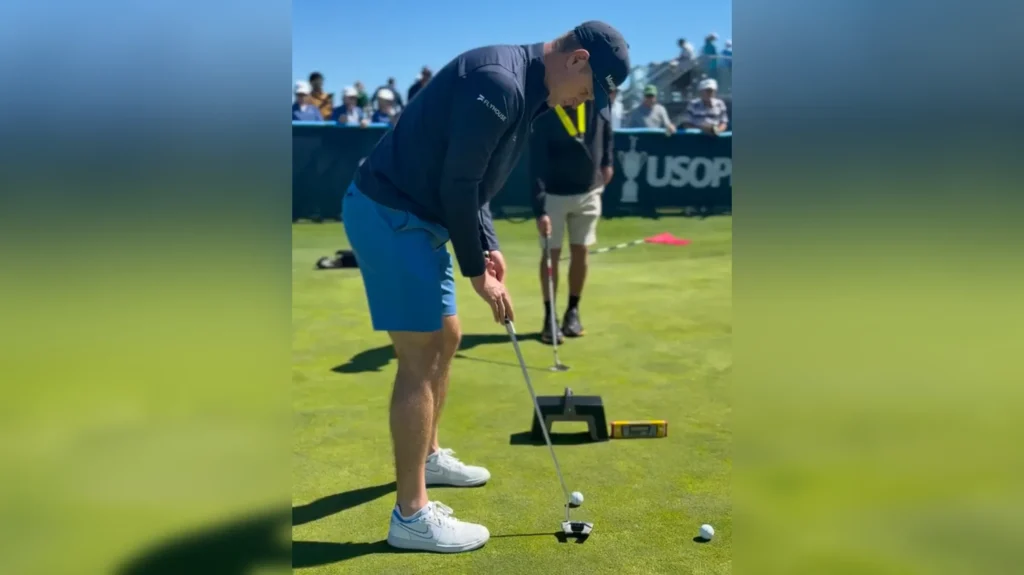
Sixty years later at the Cadillac Championship in Doral, the scenery was different, but the struggle felt strangely familiar. Justin Rose, the seventh ranked player in the world and McLaren Golf’s first major ambassador on the PGA TOUR, was +5 after two rounds, an abysmal performance for the first 36 holes played with McLaren’s Series 1 irons.
Had there been a cut, Rose would have missed it, and while the Englishman improved over the weekend, he finished T65 out of a field of 72. It was the golf equivalent of walking to the parking lot on Sunday with oil on his polo.
Just three weeks earlier, Rose had been in contention at Augusta National, battling Rory McIlroy deep into Sunday before finishing third at the Masters. Earlier in the season, Rose won at Torrey Pines with a record-setting performance that vaulted him back to No. 3 in the world, the oldest player to reach that ranking since Phil Mickelson.
At 45 years old, Rose is playing some of the best golf of his career. Which is why his surprise equipment change raised eyebrows. For a player in form, there’s usually no incentive to change anything at all, let alone their irons. And yet, just days before the Cadillac Championship, Rose announced a partnership with McLaren Golf and put the clubs directly into tournament play.
The obvious question became: why?
Why is McLaren Making Golf Clubs?
Ask Nick Collins, CEO of McLaren Automotive, and he’ll tell you that golf is “the ultimate crucible of individual determination, perseverance, resilience, intersecting with technology. A lot of those traits are there when you’re winning in a race car, or you’re developing a road car.”
In a launch video produced by Golf.com, Collins explains that “Golf resonates with those people who love motor sports, it resonates with those people who buy our cars. So there’s a really lovely intersect between the golfing world and McLaren world.”
Zach Brown, CEO of McLaren Racing adds that “there’s a tremendous amount of synergies around the technology of golf equipment and Formula 1 equipment. Materials, aerodynamics, compression, light weighting.”
So far McLaren Golf’s premise is solid, yet similar to other Formula 1 brands that have entered into golf club design. In other words, they believe their expertise in materials and aerodynamics translates to golf club manufacturing. Car people are often golf people too.
But, where McLaren begins to separate itself is in how seriously it appears to be taking the endeavor.
Unlike previous luxury car branded golf clubs, which relied on existing club manufacturers—Ferrari with Cobra or Porsche’s collaboration with TaylorMade—McLaren created its own golf division. McLaren Golf has its own leadership and team of design engineers who came from established manufacturers like Cobra, Callaway and Honma. According to McLaren, Justin Rose has been working with the engineering team for over a year, testing prototypes and helping shape the clubs before launch.
McLaren isn’t making a one-off release of clubs; it seems they have serious intent to stick around. “We’re building a brand grounded in McLaren’s high-performance DNA, and embedding it in a new sporting arena,” explains Neil Howie, CEO of McLaren Golf.
According to Howie, one of the first questions the engineering team reportedly asked internally was: “Does the shaft have to be round?”
It stands to reason that nothing is off the table in terms of design for McLaren Golf. The brand isn’t approaching the category like a licensing deal. They’re approaching it like engineers.
The Clubs
McLaren Golf launched with two sets of irons: Series 1 and Series 3.
Both are produced using Metal Injection Molding, a manufacturing process that differs from traditional forging and casting. MIM has existed in golf for several years and has been used by manufacturers like Cobra and Callaway as early as 2019, but McLaren is positioning the process as part of its engineering-first identity.
Take the Series 1 for example.
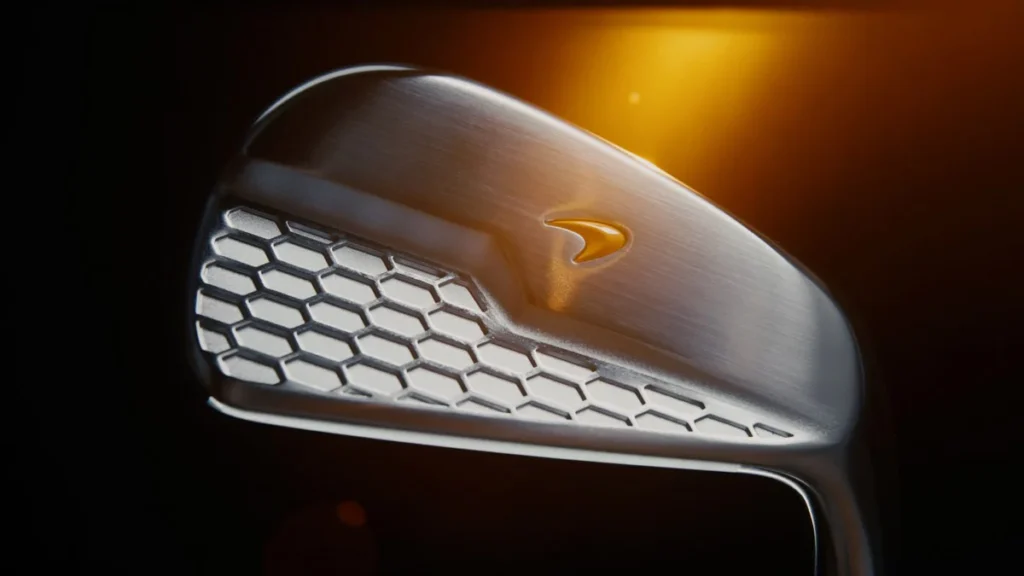
It’s a compact players iron with traditional 4-degree loft progression from the 9-iron through 4-iron and a honeycomb structure built into the cavity, a design language pulled directly from McLaren supercars. The structure allows weight to be redistributed around the perimeter of the head for stability and CG placement. All of the tech is hidden under the hood of an otherwise clean muscle-back cavity, save for the papaya McLaren logo stamped on the back.
The Series 3 is more of a game improvement iron that helps players with less ball speed get the ball airborne with maximum forgiveness. It features a carbon-fiber “bonnet” which acts as housing for the internal weighting and to dampen vibrations.
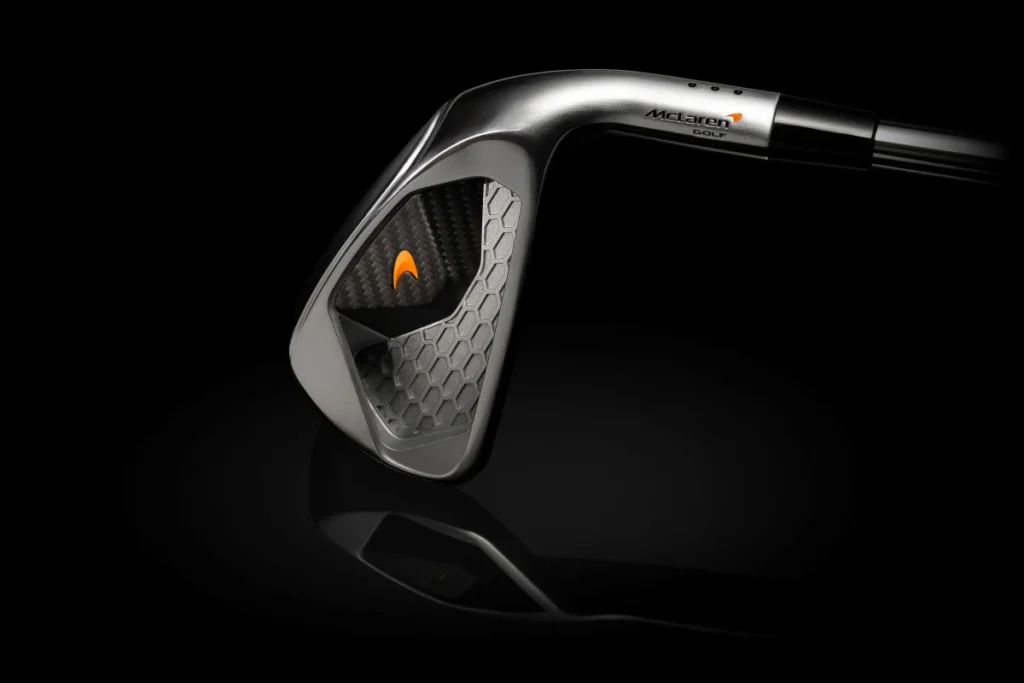
Both models are aggressively modern visually.
The Series 1, though, aimed at elite players, doesn’t attempt to hide its engineering. It’s not understated and elegant like a Miura blade or a Titleist 620 MB, although not entirely bad looking, either. The geometry is louder. More mechanical. More obviously “designed.”
Which makes sense.
McLaren road cars are not subtle either.
The starting price is $375 per iron before shaft upgrades. And, that pricing tells you almost everything you need to know about what McLaren Golf’s strategy is.
The Richard Mille of Golf
To understand the McLaren Golf pricing strategy, look no further than McLaren’s long-standing partner, ultra-high-end luxury watch brand, Richard Mille.
Richard Mille makes some of the most elaborate and visually impressive watches in the world. Their bold designs are engineering marvels which are lightweight, yet extraordinarily durable and are worn by top athletes like Rafael Nadal and Formula 1 drivers. Production of Richard Mille watches is strictly limited, with most models restricted to fewer than 100 pieces worldwide. Each timepiece demands years of development and months of painstaking, manual assembly. A microscopic flaw in a single component means scrapping weeks of work and starting over.
According to 2024/2025 Morgan Stanley and LuxConsult reports, Richard Mille has the highest revenue per unit in the Swiss watch industry (averaging roughly $250,000+ per watch), despite producing only about 5,300 pieces a year.
While McLaren isn’t alone in pricing their irons at $375 per club—Miura irons range from $310-450—the price is significantly higher than the “Big Four” manufacturers who control over 70% of the golf club and golf ball market. But McLaren Golf isn’t competing with Titleist, TaylorMade, Callaway or Ping because they aren’t following their same volume model; they are following the Richard Mille ‘revenue-per-unit’ model.
McLaren Golf doesn’t need a million people to buy their clubs, they just need to appeal to a small fraction of the market to be profitable. It’s a bet that a certain tax bracket of golfer doesn’t want a tool for a sport—they want a collectible piece of Formula 1 engineering that happens to be capable of hitting a golf ball.
That’s not to say their golf tech isn’t real, or the clubs are gimmicks. But if you look at the price to performance ratio, the McLaren Series 1 irons would have to be 175% better than the Titleist T100, the most played iron on the PGA TOUR. At $215 per club, the T100 comes with longstanding tour validation and multiple generations of iteration and refining. McLaren Golf can’t compete with that, so they have to do things differently.
McLaren Golf’s “engineering first” approach mimics the Richard Mille model of exposing the mechanics and making the process part of what the consumer is buying. Titleist, Miura and TaylorMade already create beautiful forged blades from decades of R&D and tour feedback. McLaren knows they need to bring the tech to differentiate themselves and justify the high price. It’s not just a set of clubs. It’s a system.
But they’re walking a fine line. Using Formula 1 inspired designs, newer weight distribution methods and splashing their signature papaya hue on the back may not be enough on its own to gain any meaningful traction in the golf industry.
Tour Validation
As a newcomer to the golf industry, what McLaren Golf needs for legitimacy is for its irons to be in the bag for a win in a professional golf tournament.
L.A.B. Golf was once considered an outsider with weird looking putters until J.J. Spaun won the 2025 US Open with a 65-foot putt using his DF3. The win immediately thrust the Oregon -based putter company into the mainstream. L.A.B. has since sent shockwaves across the entire putting industry with their lie angle balance technology, forcing other brands to play catchup and release their own version of a lie angle balanced putter to keep pace.
Tour validation is a huge catalyst for growth for club manufacturers and the bet is that Justin Rose will win a tournament with McLaren clubs. It’s not a bad bet, either. Rose is currently the seventh ranked player in the world with 13 career wins on the PGA TOUR and 12 wins internationally. Of those wins, he has used no less than three distinct sets of clubs: He won the 2013 U.S. Open with a full bag of TaylorMade clubs, the 2019 Farmers Insurance Open with Honma clubs and the 2026 Farmer Insurance Open with a mixed set of Miura, Titleist, TaylorMade and Callaway clubs.
With Rose an investor in McLaren Golf, he’s also betting on himself.
While potentially a positive, this is also a double-edged sword. As the only player on the PGA TOUR currently using McLaren Golf irons, Rose’s performance is now directly linked to the performance of McLaren golf clubs. Even if his double bogey on the first hole at the Doral was due to a bad drive, a club McLaren hasn’t yet released, the online chatter is, “Rose played poorly because of his new McLaren clubs.” This negative chatter will only get louder the longer Rose doesn’t post good numbers with McLaren Golf clubs in the bag.
Rose being an outward investor in McLaren Golf is also a potential negative in that his adoption of the equipment is not organic based on performance. J.J. Spaun was not sponsored by L.A.B. Golf when he won the U.S. Open. He chose to use a DF3 because he putted really well with it. The organic adoption of L.A.B. putters among elite players signals the technology is real, which is better advertising than any Super Bowl ad could buy.
This is where 8AM Golf comes in.
The 8AM Advantage
McLaren Golf isn’t going it alone when it comes to support for the venture. It’s part of 8AM Golf, an ecosystem of premium golf media, equipment, event and travel brands founded by Howard Milstein with Justin Timberlake as a partner.
8AM Golf properties include traditional Japanese club maker, Miura, golf publications Golf Magazine and Golf.com, Payntr Golf, which makes Justin Rose’s golf shoes, as well as McLaren Golf and True Spec Golf, one of the exclusive fitters for McLaren Golf clubs. It’s an army of high-caliber golf partners who all have a stake in each other’s success. Most importantly, 8AM Golf allows McLaren to bypass the traditional golf retail ecosystem entirely, avoiding a “floor war” with Titleist and TaylorMade in direct cost to performance comparisons by customers at the PGA TOUR Superstore or Golf Mart.
This is where McLaren Golf really separates itself from previous attempts at golf club design from luxury car brands and explains why they might succeed where the others failed. With 8AM Golf, McLaren can control the narrative in ways that support their luxury image. With built in fitting channels like True Spec Golf, McLaren Golf can sell their clubs as an experience, a system finely tuned to each iron rather than a set of golf clubs.
By selling through premium fitters, McLaren Golf is able to control presentation and maintain the level of personalization that luxury consumers want. And, due to the 8AM Golf connection to established golf media outlets, they’re also able to control messaging.
With Golf.com and Golf Magazine inside the same ecosystem, McLaren Golf enters the market with immediate access to visibility, editorial coverage and an audience already conditioned toward premium golf products. The 8AM Golf partnership is able to provide McLaren Golf much more of a “luxury watch” model than traditional golf retail.
The structure dramatically increases McLaren Golf’s runway in an industry where most equipment startups never survive long enough to iterate. But eventually, every golf club company runs into the same problem: performance.
Where the Rubber Meets the Road
People don’t buy a Richard Mille watch because they need to know the time. It’s a luxury, a status symbol, an investment in the process and brand philosophy more than its function of telling time.
This is not the case with a luxury golf club, which has a function beyond representing an idea or appearing as a status flex. A golf club, no matter how luxury or engineered it is, has to contend with the scorecard at the end of the day.
Richard Mille makes Rafael Nadal’s watch. They’re not trying to make his racket.
While McLaren Golf isn’t competing with Titleist on price, they are competing with them on performance, whether they want to or not.
Speed Bumps Ahead
Despite the fact that McLaren Golf is doing things differently to gain a foothold in the industry long term, they face an uphill battle.
Where Richard Mille can design their watches to almost infinite configurations, McLaren Golf can only push so far. Their biggest competitor isn’t other golf club manufacturers, but the USGA and R&A, which place hard limits on equipment performance. McLaren can only push club designs so far before regulations flatten the innovation curve back toward everyone else. There’s also the unavoidable reality that if the clubs don’t perform as well as the price implies, golfers will not care how interesting the engineering story is. If the performance isn’t better than what is out there for half the price from legacy golf brands, why buy McLaren Golf clubs other than for status?
Continued poor performance from Rose will also start to weigh on the McLaren Golf brand and send it into the wall quicker than Leclerc at the Miami Grand Prix. If things start to go in that direction, Rose can always work with McLaren Golf’s R&D team to tweak the designs to work better for him.
Rosey is one of my favorite players and I am excited about McLaren Golf. I think having a manufacturer whose premise is to question and experiment is only good for the game, that is if they make an honest attempt to iterate and come up with designs that improve players scores.
The unfortunate truth though is elite players are sticky with their gear and the best players in the world often use less tech, not more. They want some forgiveness at the top end of the bag but control in their scoring clubs, which is why many of the top ten players on the PGA TOUR, including world number one Scottie Scheffler, Rory McIlroy, Cameron Young, Collin Morikawa and Tommy Fleetwood play muscle-back blade irons at least through the mid irons—clubs which have little to no technology in them but provide the most feedback and allow the most control and shot shaping capabilities. Rose himself, during stretches as a gear-free agent, played Miura MC-502 irons in part of his set.
There is a risk that McLaren Golf over engineers their clubs for the sake of being different and they may have to consider that a successful golf club might not be inspired by a Formula 1 car part. It might just be a well-designed single piece of metal on a stick.
If McLaren Golf comes up with sticks and not schticks, they have a real shot.
Either way, McLaren Golf entered the world on April 29, 2026. What date follows it on the headstone — whether short-lived like the luxury car-branded golf clubs that came before it, or decades long and still counting, like McLaren Racing itself—is up to them.