It can be really hard to get a tee time these days, especially on weekend mornings. Luckily, there is a number you can use that can make snagging one of those prime tee times a little easier.
That number? Chance of precipitation.
The higher the percentage chance of rain in the forecast, the more tee times seem to magically appear as the day approaches. If you’re willing to take your chances when others aren’t, you might just have the course to yourself.
I had this exact scenario play out last week at Bethpage Red. I was shut out getting a tee time for the weekend, but Sunday’s forecast looked wet. As the week went on, I was able to pick up a dropped Sunday morning tee time, and the morning of, I was able to tee off 45 minutes early because people weren’t showing up. It rained the whole round, but we played lightning fast. With the right gear, even a steady rain doesn’t need to ruin your round.
You just need to be prepared.
Here is what I bring to stay covered, dry, and thinking about my next shot rather than the weather.
All products featured in this article have been personally tested by The Golf Player. Opinions are our own. We may earn a commission from purchases made through links in this article, at no additional cost to you.
Golf Umbrella
Without a good golf umbrella, you’re totally sunk if the heavens open up. You want to look for a golf umbrella with a large canopy to keep your bag dry. While you’re hitting, the umbrella goes in your bag like one of your clubs, and you need the canopy to be large enough to cover as much of the bag as possible to protect the base of the bag from soaking through and wetting your grips.
A non-negotiable is wind vents. Without them, the wind will either rip your umbrella inside out or send it flying down the fairway past your drive.
My favorite golf umbrella is the Golf Umbrella by Weatherman.
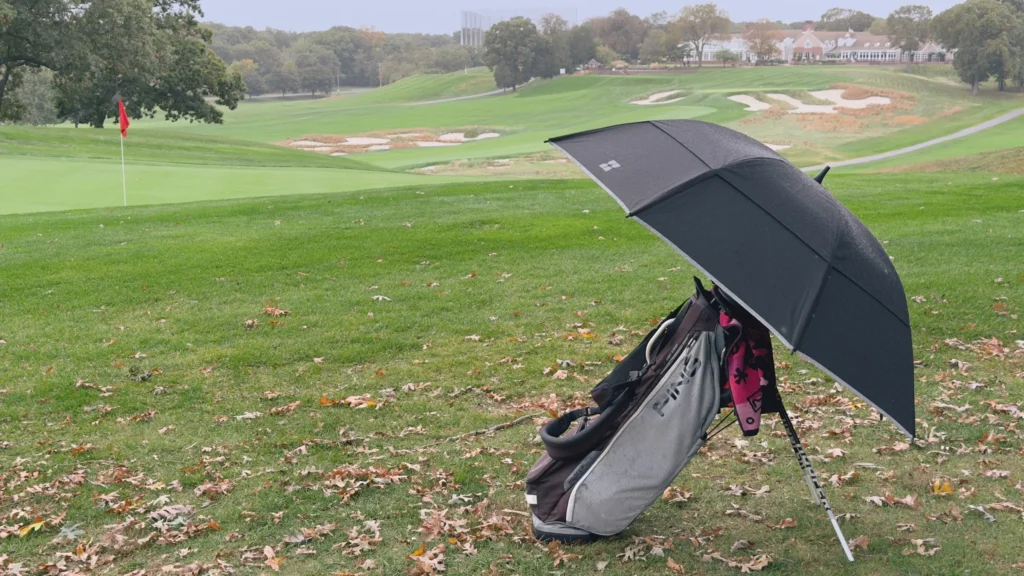
It has a massive canopy, with an open diameter of 56 inches and a full arc of 66 inches. Made from 100% recycled fabric, the Weatherman Golf Umbrella is built rock solid and, according to Weatherman, has been wind tunnel tested to withstand winds up to 55 mph.
At just 1.87 pounds, it’s surprisingly lightweight, which is key for the times you carry the umbrella but might not need it all round. When you are using it, it’s easy to carry and almost glides along with you as you walk.
If it’s raining hard, I’ll put my towel up inside the canopy of the umbrella. From that position, it’s virtually impossible for rain to get it wet. It does add some weight and makes the umbrella more top-heavy, but that’s a trade-off I’m happy to make rather than leave a towel hanging from my bag where it can get wet from rain blowing in sideways.
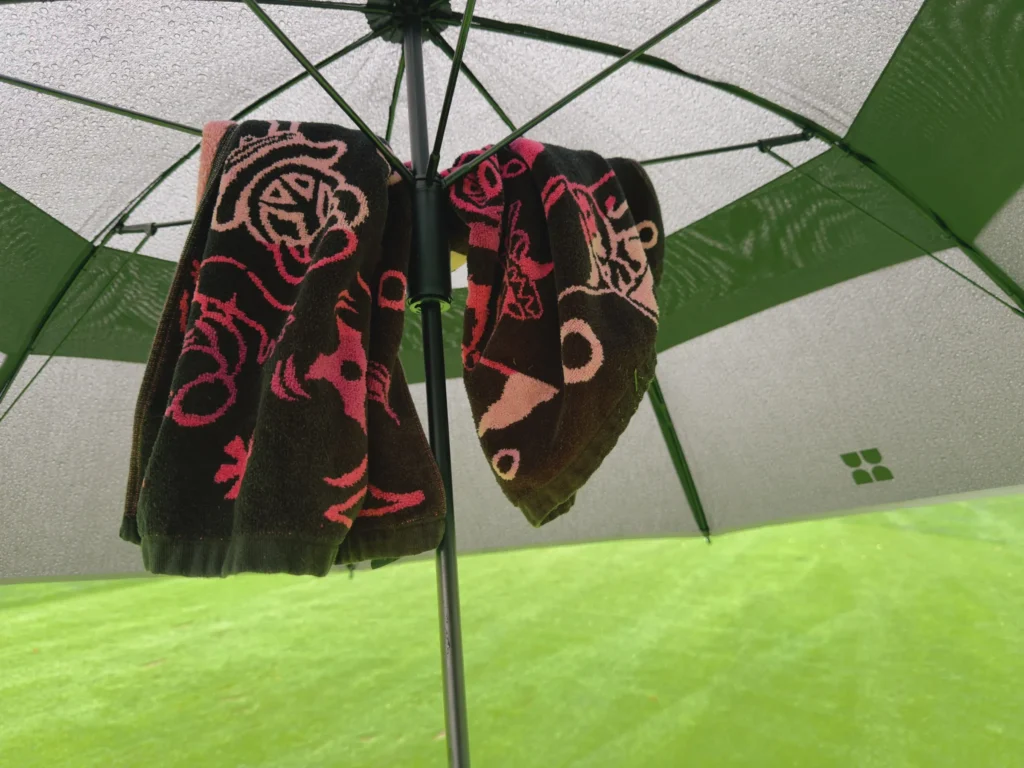
When playing in the rain, it’s vital to keep the clubface dry as much as possible before hitting. Any water between the clubface and the ball can lead to unpredictable ball flights. With the umbrella in my golf bag and the canopy open, I like to wipe the clubface dry with my towel, then grip the club underneath the umbrella. This keeps the grip, my glove, and the clubface dry.
You’ll see players on TOUR do this, except their caddie is holding the umbrella over. The caddie walks away just as the player steps in to hit the ball, minimizing the time the clubface is exposed to the rain. Since I don’t have a caddie, gripping the club underneath the umbrella achieves a similar result, and it worked really well for me.
Waterproof Golf Shoes
If there is even the slightest chance of rain, I skip the spikeless shoes and grab my waterproof golf shoes with Softspikes. I want as much traction as possible to avoid slipping on wet grass.
I love my FootJoy Premieres. They have a classic look that works rain or shine, and most importantly, they come with a two-year 100% waterproof warranty from FootJoy. I’ve played many wet rounds of golf in these shoes, and they’ve been reliable workhorses. Of course, in heavy enough rain, water will eventually find its way into any shoe from above, but I can’t really fault the Premieres for that.
Rain Pants
Rain pants can help keep water from entering your shoes from above, provided they fit properly over the shoe collar. And, of course, they’ll keep your pants dry.
I love my J.Lindeberg rain pants. I bought them over ten years ago, and they’re still working great today. They have everything you’d want in a rain pant: they’re lightweight and waterproof, with adjustable tabs at the waist and zippered hems that make them easy to pull on over your golf shoes. J.Lindeberg has since updated the style from the pair that I own, but the overall design remains similar.
Rain pants also make a great layer even if there is no chance of rain. I wear rain pants over shorts for chilly mornings that will warm up after a couple of holes. They are lightweight and roll up small so they don’t take up much room once you do take them off.
If it’s just drizzling, you might be able to get away with just wearing rain pants without a rain jacket. Your pants will take more water as you’re walking through damp grass that kicks up water with each step. Without them, the bottom of your pants can get saturated from kicked up water on the grass alone.
Rain Jacket
While playing NCAA Division II golf for Chico State, we played many rounds in the rain. Unless it’s torrential to the point of unplayable or there is lightning in the area, practice is on, rain or shine—the idea being if it’s raining during a tournament round, you need to be comfortable playing in the rain. Back then, I hated wearing a rain jacket. It was the one piece of rain gear that I felt changed my ability to swing freely, so I would only put on a rain jacket if absolutely necessary.
My stance on golf rain jackets has changed today. If you can find a rain jacket that is not only waterproof but also has a little bit of stretch to the material, that extra stretch will make all the difference.
I love Zero Restriction’s Conquistador Waterproof Hooded Jacket. It’s lightweight, with waterproof fabric containing 8% spandex that gives just enough stretch to be able to swing without feeling restricted. I wore it during my rainy round at Bethpage last week and forgot I was wearing a rain jacket at all. It wore like any outerwear layer and not some cumbersome rain jacket.
The Conquistador Waterproof Hooded Jacket provides a little bit of warmth as well. It was 62 degrees during my rain round and I was borderline warm at times wearing the jacket all day, but it ended up providing the right amount of warmth for that temperature. If it’s colder, the jacket has enough room in the fit to allow for a vest or thermal layer to be worn underneath.
I was really impressed by the details of this jacket. The arm length was perfect so I wasn’t constantly pulling the cuffs away from my hands while I gripped the club. The cuffs use what Zero Restriction calls a “dot-lock closure”, which felt more like snapping Legos together than simple Velcro. It felt solid and secure.
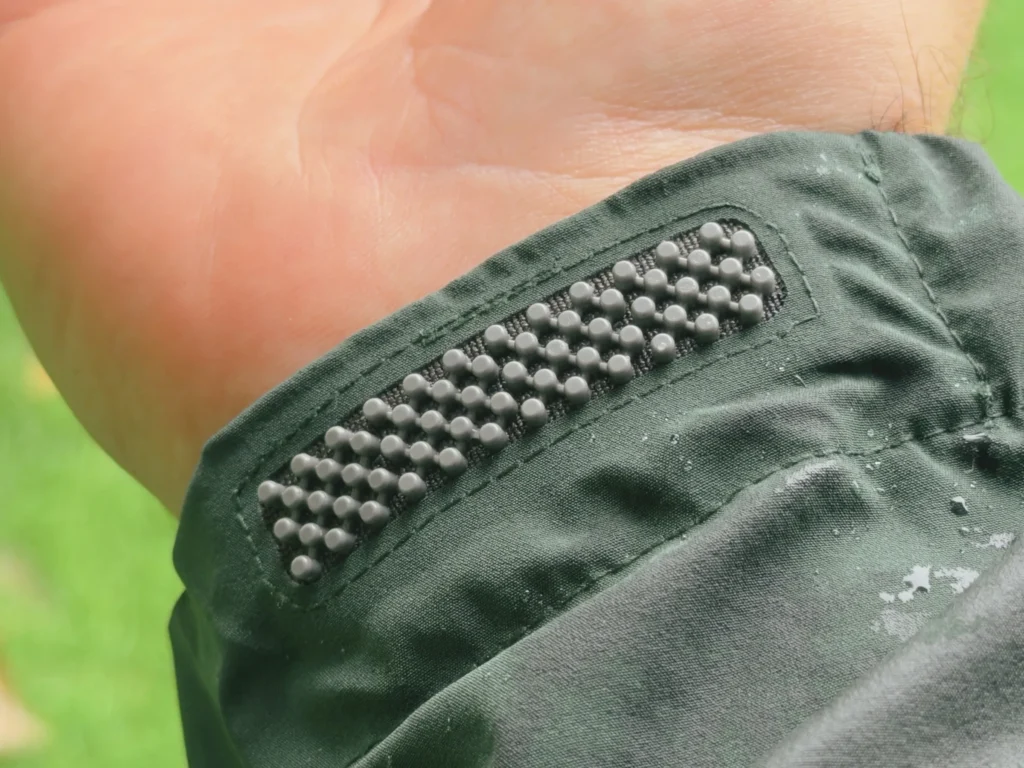
Having a high-quality rain jacket that doesn’t impede your swing gives you so much less to worry about during your round and is well worth the investment.
Rain Gloves
Keeping both your club grips and gloves dry is paramount to limiting the possibility of the club slipping during your swing.
Standard leather gloves weren’t made to get wet, but if you manage the glove during the rain, you can get pretty far with a standard glove. If it’s really raining though and your club grips or glove get saturated, you might need something with more traction on the wet grip.
I use the FootJoy RainGrip Gloves, which are specialty golf gloves that are made to get wet. They are sold in pairs so you can wear them on one or both hands. Rain gloves are thicker than standard leather gloves, which changes the way the club feels in my hand. I bring them with me during rain rounds, although I put them on only as a last resort. If your grips get wet, wearing two rain gloves gives you the best chance of keeping the club from slipping at impact.
Even though it was raining steadily during my round last week, I managed to keep my grips and glove dry enough that I never needed to put on my rain gloves. By storing my leather glove in my waterproof rain jacket pocket and gripping the club underneath my umbrella, I was able to limit how long the glove was exposed to the rain. This is where having a quality umbrella and rain jacket can save you in more ways than one.
The only time the club slipped in my hands was on my final iron shot of the day, as I hit my approach to the 18th green. Not bad for a round played entirely in steady rain.
Final Thoughts
When it’s raining on the golf course, your job becomes keeping your grips, clubface, and glove as dry as possible. Having the right rain gear makes that job much easier, but not all rain gear is created equal. Just because it makes a “whoosh” sound doesn’t mean it’s actually waterproof.
Quality rain gear is one of the more expensive purchases you can make for golf. It can be hard to justify spending that much on something you might only use a handful of times each year, but it’s also one of those purchases where you really do get what you pay for.
I treat rain gear as more of an investment than a purchase. Unlike your favorite polo, which might get worn several times a month, rain gear might only come out of the closet a handful of times each year. With proper care and relatively little wear, quality rain gear can last for many years. My J.Lindeberg rain pants are over a decade old and still going strong. I get a minimum of three years out of my FootJoy Premieres and end up replacing those due to wearing them out rather than losing their waterproofing.
Invest in the right rain gear, and rainy days might become more playable than you previously thought. The next time there’s rain in the forecast, instead of asking for a rain check, you’ll be saying: Rain? Check.