Four-time Open Champion and 15-time PGA TOUR winner Bobby Locke is credited with coining one of the most frequently repeated quotes in the game— “drive for show, putt for dough.” In the saying, Locke, who was an exceptional putter, implies that while driving it long off the tee is fun to watch, it’s ultimately putting that wins tournaments.
That might have been true during Locke’s time, but in the strokes gained era we’ve learned that putting, though massively important, isn’t the be-all-end-all to tournament victories as once thought—and to win at TPC Sawgrass Stadium Course at THE PLAYERS Championship this past weekend, Cameron Young and Ludvig Åberg demonstrated that you need to not only putt for dough, but drive for it as well.
Åberg’s Unraveling
Ludvig Åberg started the day at -13 with a three shot lead over Michael Thorbjornsen, four clear of Cameron Young. The two-time PGA TOUR winner led or co-led the tournament ever since the 9th hole on Friday and looked comfortably in the driver’s seat with just eight holes to play. Things can change quickly on the Stadium Course at TPC Sawgrass, and it took just two holes for Åberg to essentially play himself out of contention.
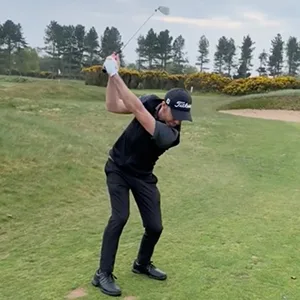
The smooth swinging Swede’s unraveling began on the 11th hole where despite finding the fairway from the tee, a synchronization issue was brewing in his swing. A slow-motion replay close-up of Åberg’s driver face during the CBS telecast showed the ball was hit considerably off the toe, a sign that his arms were out of sync with his body. After finding the water on his second shot, Åberg walked off the par-5 11th hole with a bogey.
Åberg’s drive on the 12th tee once again was hit off the toe, this time hooking into the water hazard to the left of the fairway, an errant tee shot that ultimately led to a double bogey. The back-to-back miscues into the water ballooned Åberg’s round from even par to +3 at a time when the group ahead of him played the same two holes at a combined one under par.
Åberg stood on the 11th tee two shots ahead of Fitzpatrick. Two holes later he trailed Fitzpatrick by three.
It was a remarkable reversal, one that completely upended the leaderboard and let the penultimate group back into the tournament.
It seemed like Fitzpatrick—who hadn’t made a bogey all day—was next in command until a three-putt on the brutal 14th green, with its pin position dastardly placed along a ridge, gave his playing partner, Cameron Young, a putt to tie for the lead. Young made the clutch 6-footer which set the tone for a Young vs. Fitzpatrick match play style finish with the pair all square with four of the most difficult and volatile finishing holes in golf left to play.
Putt for Dough
A birdie on 15 put Fitzpatrick one ahead of Young, a lead the 31-year-old Englishman would take to the par-3 17th tee. Holding honors, Fitzpatrick played first to the often disastrous island green with a conservative line to the center of the green. Safely aboard and reasonably assured a two-putt par, Fitzpatrick forced Young to make a move.
As chants of “U-S-A” rang out from spectators that packed the mounded stadium hills wrapping around the 17th hole, Young took the more risky line just left of 17’s famous back right Sunday pin position—a perfectly executed 57-degree wedge that hopped to the right and stopped just 9 feet, 7 inches from the hole.
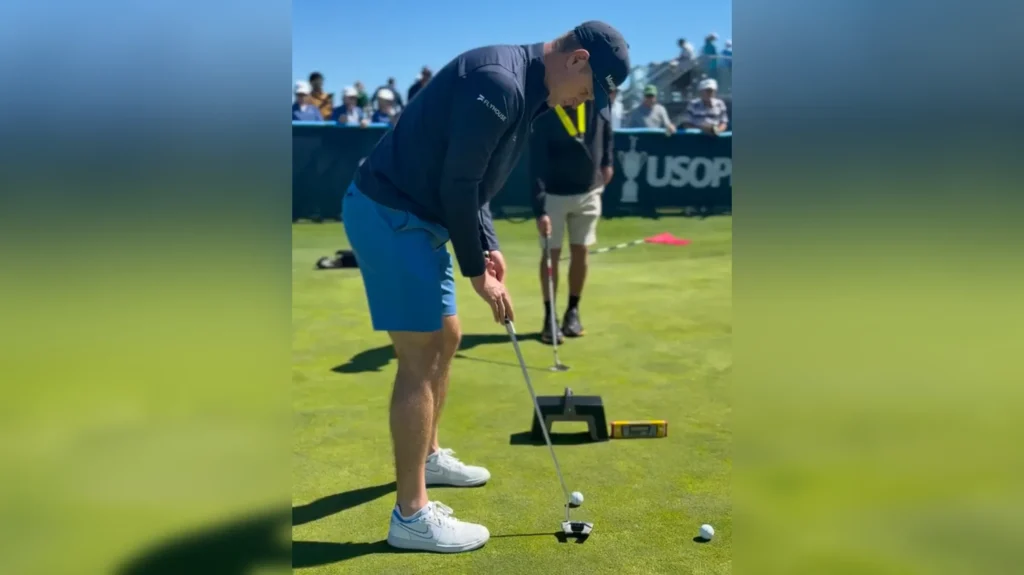
Young’s birdie putt fell with little pace to spare in one of the tournament’s most dramatic moments which once again brought the group to all square with one to play.
Drive for Dough
It was Young who now held honors and could set the tone for how the 72nd hole would be decided. He quickly and decisively pulled driver even though the 18th was playing downwind at over 20 mph—help that some players took and were opting for a long iron or fairway metal to take some risk out of the water along the entire left side.
Young, however, took the risk head-on and absolutely pummeled a perfect drive 375 yards into the fairway.
It wasn’t just the longest drive of the tournament—it was the longest drive on the 18th hole at TPC Sawgrass Stadium Course in the Shotlink era. In other words, with the tournament on the line, Cameron Young hit the longest drive on the 18th going back to when the PGA TOUR started collecting Shotlink data in 2004.
Fitzpatrick’s drive went through the fairway and into the pine needles which left him no option but to punch out close to the front of the green and try to get up-and-down to save par. Young was left with only 100 yards in and from the fairway was able to generate enough spin to keep the ball just on the back fringe in a strong helping wind that was making the green increasingly difficult to hold.
Fitzpatrick’s attempt for an up-and-down par was ultimately unsuccessful, clearing the stage for Young to clean up his 8-inch par putt to claim his second PGA TOUR victory.
Lessons From the Ryder Cup
Speaking to the press after the tournament, Young was asked about what was going through his mind standing on the 18th tee. “My thought process over that ball is, one, making sure that I’m committed to my line. And two, the overarching thought is, ‘I’m going to hit the best shot of my life right here.’” When asked to rank the shot against others in his career, Young was clear. “I don’t know if I can think of one that’s better,” he added. “It’s one of the best shots I’ve ever hit in my life.”
It was also the first time Young had been in the position to win or lose a tournament on the last hole, not that he hadn’t been in contention in the past. On the 72nd hole of the 150th Open Championship at St. Andrews, Young delivered another clutch drive to the 18th green and made the eagle putt to card a blistering -7 (65). That eagle earned him a solo second finish, one stroke behind winner Cam Smith and one stroke ahead of Rory McIlroy.
Young’s only win prior to THE PLAYERS was the 2025 Wyndham Championship where he won by six strokes and was never really in any danger of losing coming down the final nine holes.
To deliver clutch moments at TPC Sawgrass under intense pressure, the 28-year-old credits his experience at the Ryder Cup at Bethpage Black. “Dealing with nerves is tricky. Your senses are kind of heightened, typically I hit the ball a little farther, so it makes you capable of more but if you kind of let them get in the way, obviously it can kind of be disastrous. It is a balancing act of knowing that they’re there and trying to use them to the best of your ability,” Young said after his PLAYERS victory.
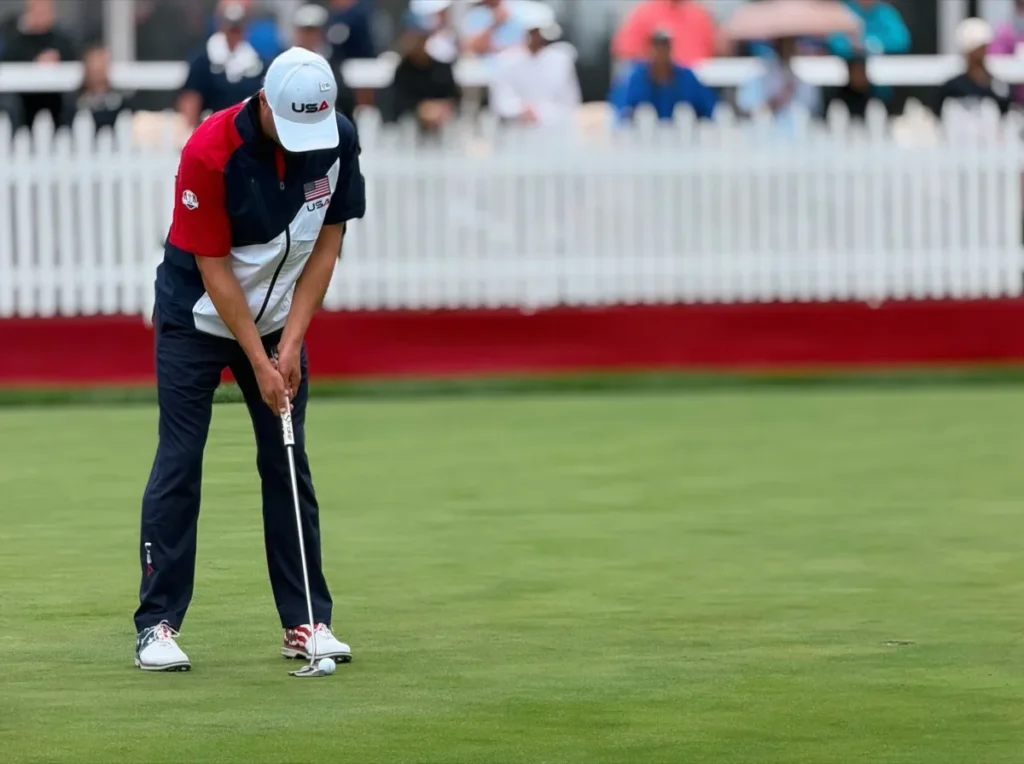
Young was a Captain’s Pick for Team USA at the 2025 Ryder Cup at Bethpage Black, where he emerged as one of the team’s top point-earners. In a blistering 3-1-0 debut, Young notably teamed up with Bryson DeChambeau to secure a point against none other than the European duo of Ludvig Åberg and Matt Fitzpatrick—the same two men he battled against at the Stadium Course on Sunday.
“Ryder Cup, looking back I think is a huge learning experience on how I personally deal with those nerves and what I can do when I do feel that way.”
That psychological breakthrough was the silent engine behind the most important shot of the tournament. It allowed Young to lean into the nerves and harness them for good rather than something to buckle underneath.
While one could argue Fitzpatrick’s putt on 18 could have saved the hole, it was really his drive into the pine needles that put him against the ropes. A good putt can only bail out a poor tee shot so many times. This is where the fallacy of Bobby Locke’s quote comes into play. A player certainly needs to putt well to win, but they also need to drive it well, or at least well enough to put themselves in a position to make a putt to win. It was Åberg’s driver that ultimately derailed his PLAYERS bid and Fitzpatrick’s poor drive on 18 that gave the advantage to Young, who essentially won the tournament not with his putter, but with his driver.
With his record-setting drive on the 72nd hole, Young showed that drives aren’t just for show, and there is a term in golf for a player who can hit long and straight drives on aggressive lines in pressure packed moments: THE PLAYERS Champion.